Have you ever encountered situations where formwork was delivered to a construction site in three trucks, but on the return trip, you could barely fit all the equipment into four or even five trucks? This leads to unplanned logistics costs, which can reach as high as 30,000–50,000 UAH.
Or perhaps you suddenly ran out of small parts (screws, Tie nuts) during installation, even though the supplier insists they provided everything needed—and even extra? In the end, it turns out the parts were simply lost on the construction site due to disorganized storage.
Or perhaps all the formwork was undamaged after the concrete work was completed, but the supplier claims that some components need repair? It turns out the guys loaded all the equipment loosely into the truck and didn’t secure it properly, resulting in additional equipment repair costs.
If these issues sound familiar to you, our article will be helpful. After all, one of the possible causes of such situations is improper handling of the formwork—specifically, its palletizing, loading onto the truck, and unloading at the job site.
Rules for Storing Formwork
Based on our many years of experience and real-world case studies from our clients, we have developed a set of recommendations, including guidelines for the proper storage of various components of vertical and horizontal formwork, to ensure safe and cost-effective equipment transport.
Panels
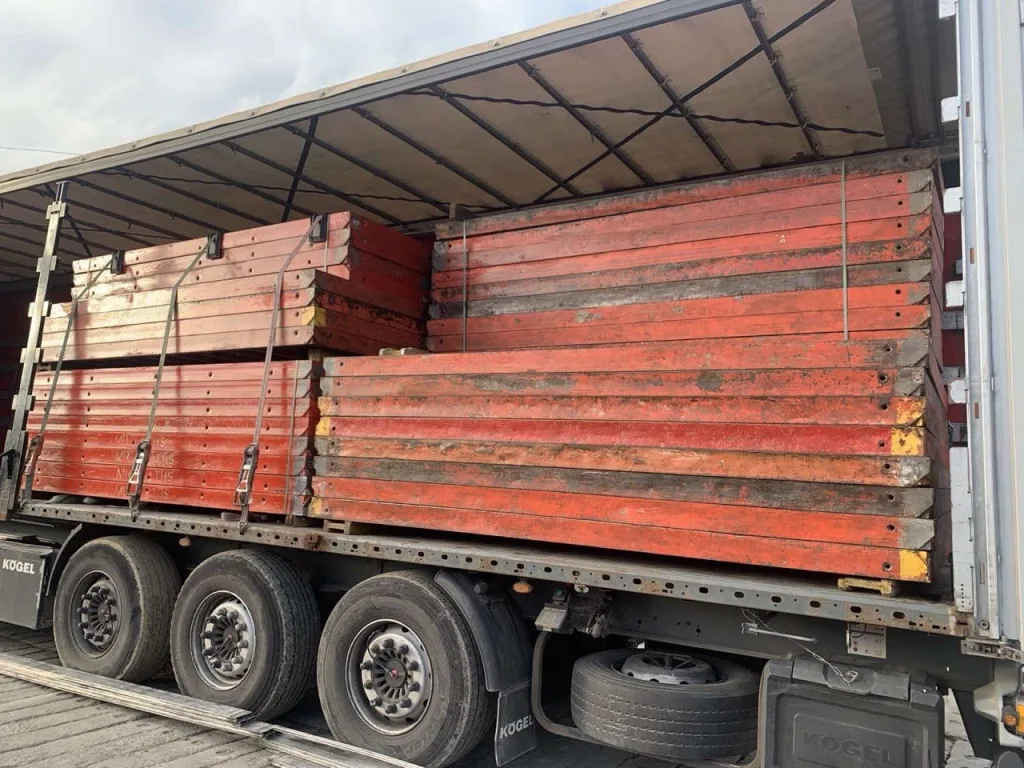
: Panels up to 1.2 m in length are stacked in bundles of 8; large panels (2.40 m) are stacked in bundles of 4, allowing them to be loaded into a truck without exceeding standard loading parameters. If the panels are 1.2 m wide, then two bundles can be placed side by side. This ensures the stability of the structure during transport and reduces the risk of shifting during transit.
Bundle formation standard:
- The bottom panel of the stack is placed with the plywood side against the beams.
- The next panels are made of plywood all the way to the top.
- The top panel of the stack must be made of plywood all the way to the top.
The stacks of panels are placed on a crossbeam.
Beams
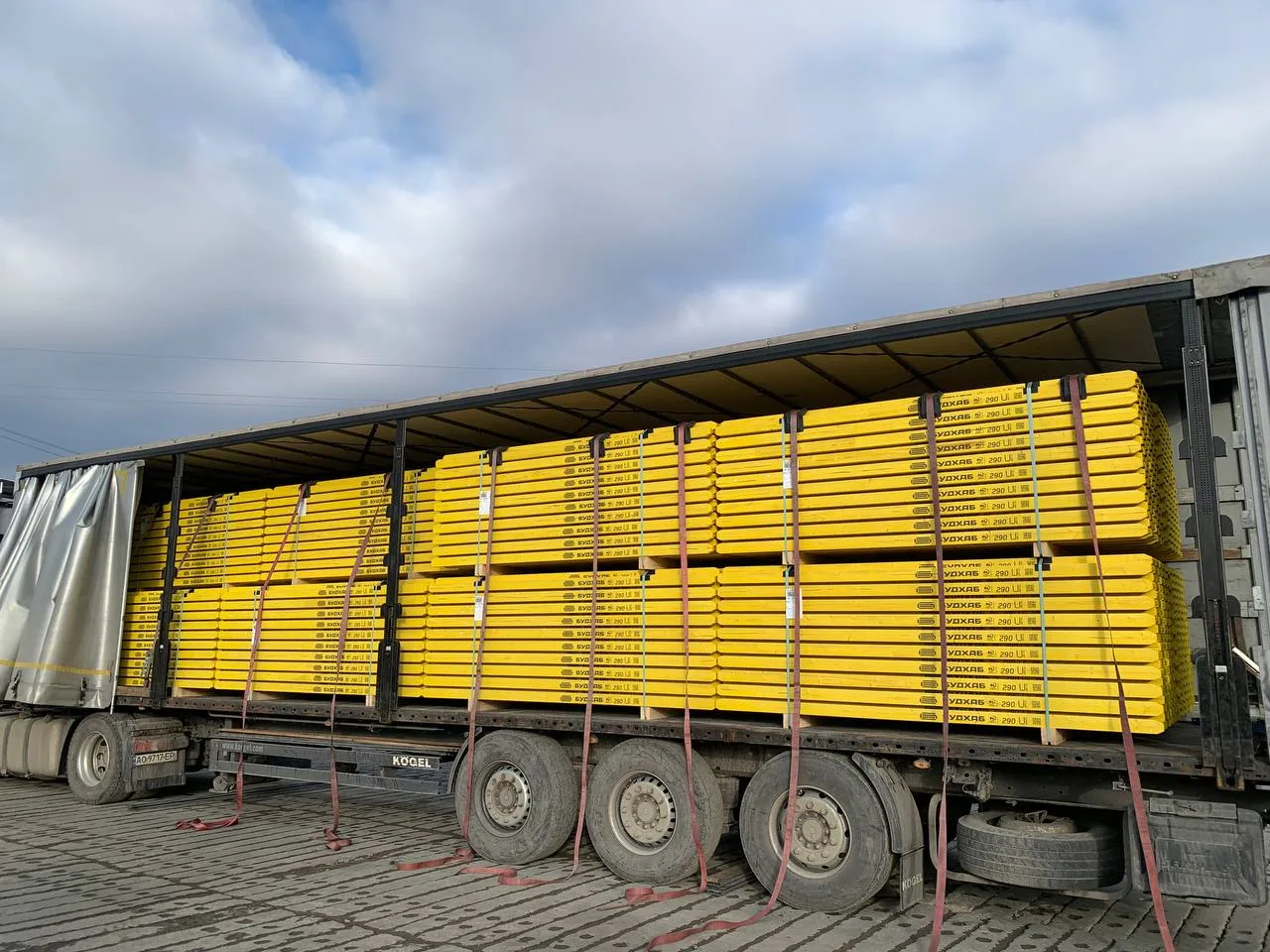
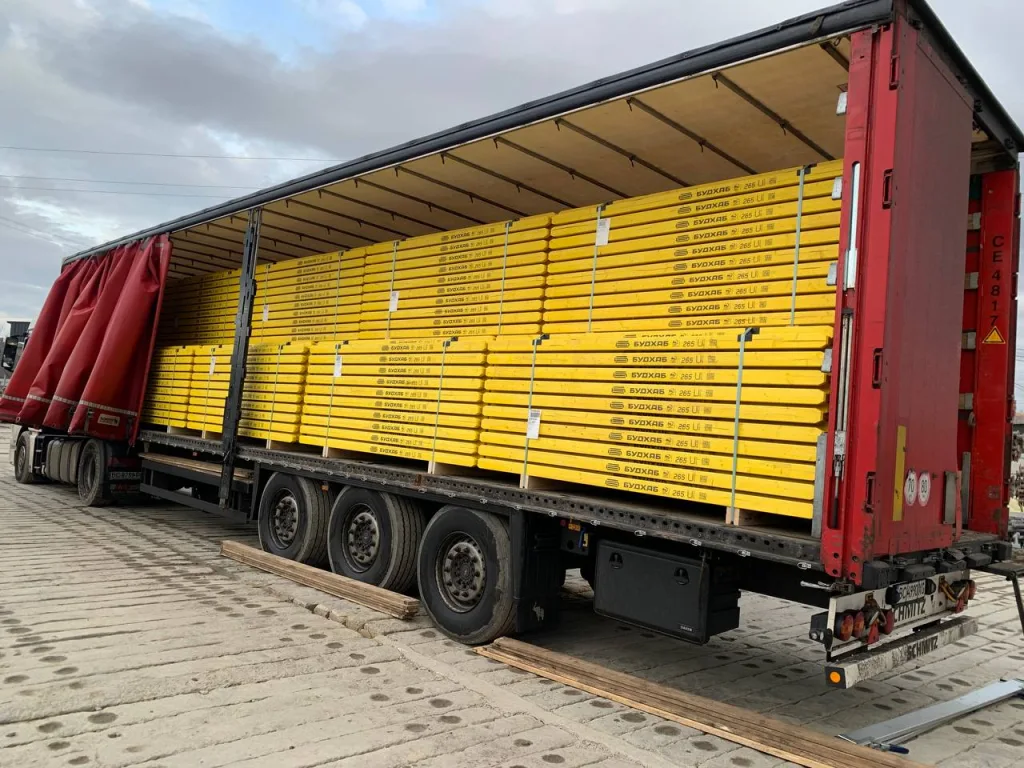
If you need to transport beams, it is best to stack them in bundles of 80. Each bundle is 1.10 m wide, so they can fit side by side in a standard truck (2.45–2.50 m). There are 5 pieces in a row. The total number of rows is 16. The total number of beams is 80.
The stacked bundles of beams are placed on a crossbeam (1.15 m long). By stacking them in 16 rows of 5 pieces each (in two layers), you not only save space but also distribute the load evenly, which prevents the transport floor from warping.
Bundle formation standard:
- All the edges of the beams in the bundle must be aligned with each other.
- Each row is offset from the bottom row by half the width of the beam.
- The bundle is secured with tape on both sides.
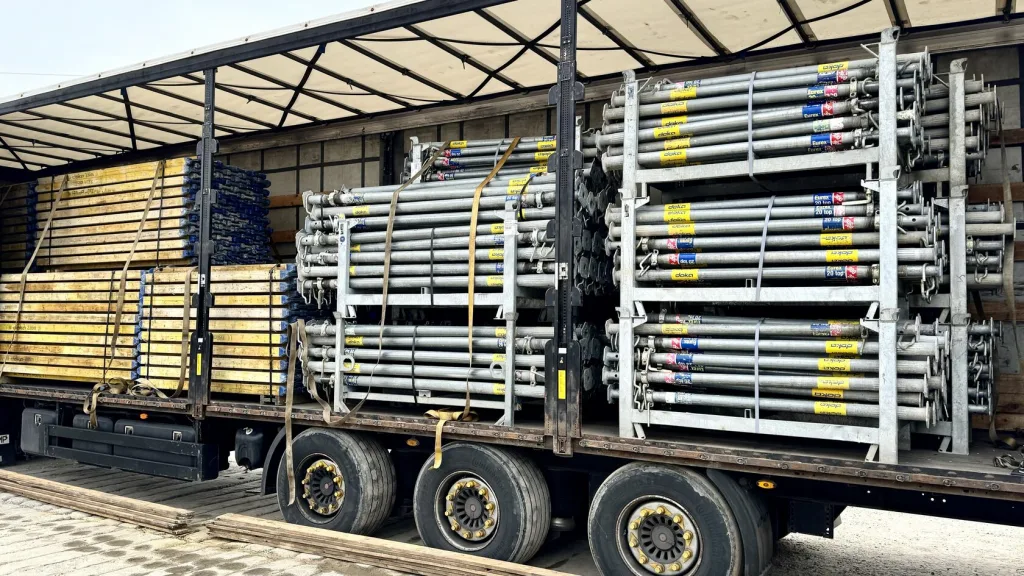
Uprights, plumbing struts, and crossbars
are always stacked on pallets, which greatly simplifies their transport. It is important to avoid stacking them loosely with a pile on top, as this prevents efficient use of space and leads to damage to the equipment. The uprights are of standard length, so pallets can be stacked two or three high, which increases transport capacity.
To this end, we use certified (EPAL) pallets measuring 80 x 120 cm and 80 x 150 cm, which are capable of withstanding heavy loads and comply with European safety standards.
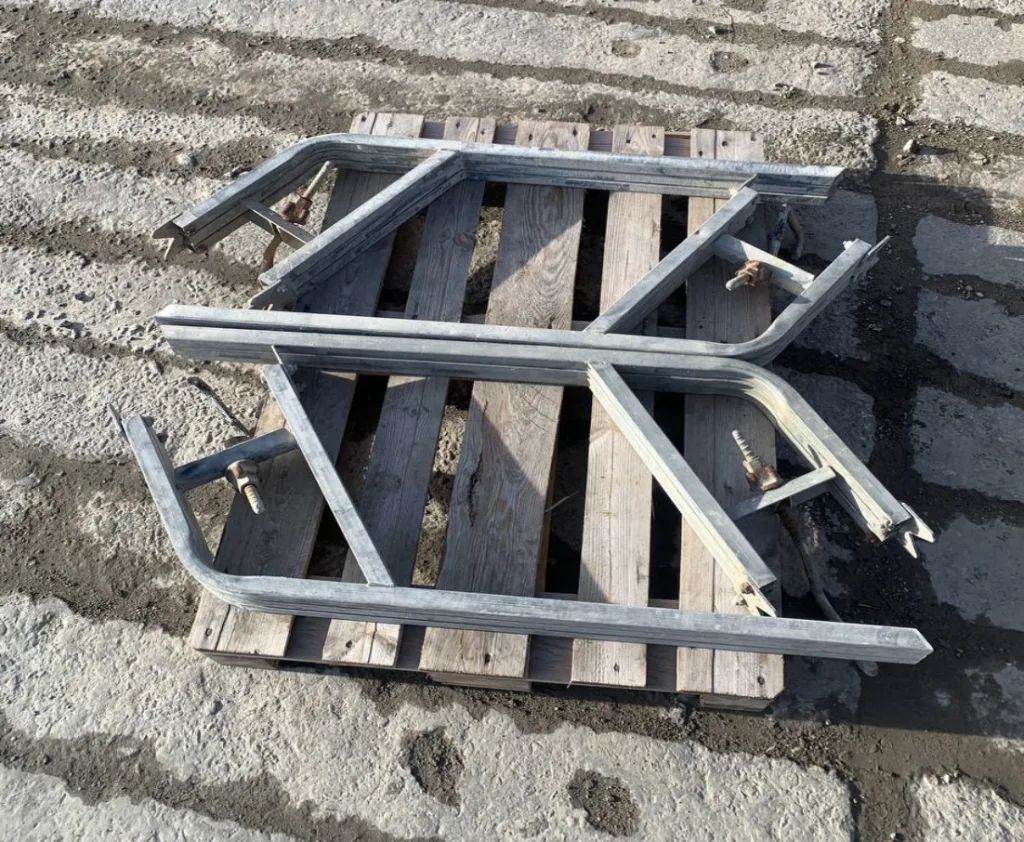
Tripods
: Stack the tripods onto pallets. To make efficient use of space, they may be stacked in two layers, but the tripods themselves should not be secured with metal straps. It is important to ensure that the stack is stable and upright to prevent damage during transport.
Standard for forming bundles with Tripods
- The stack is secured with metal tape.
- Number of rows in height: 15
- 4 pieces in a row
- Total quantity: 60 pieces
- The rows are arranged perpendicular to the bottom row.
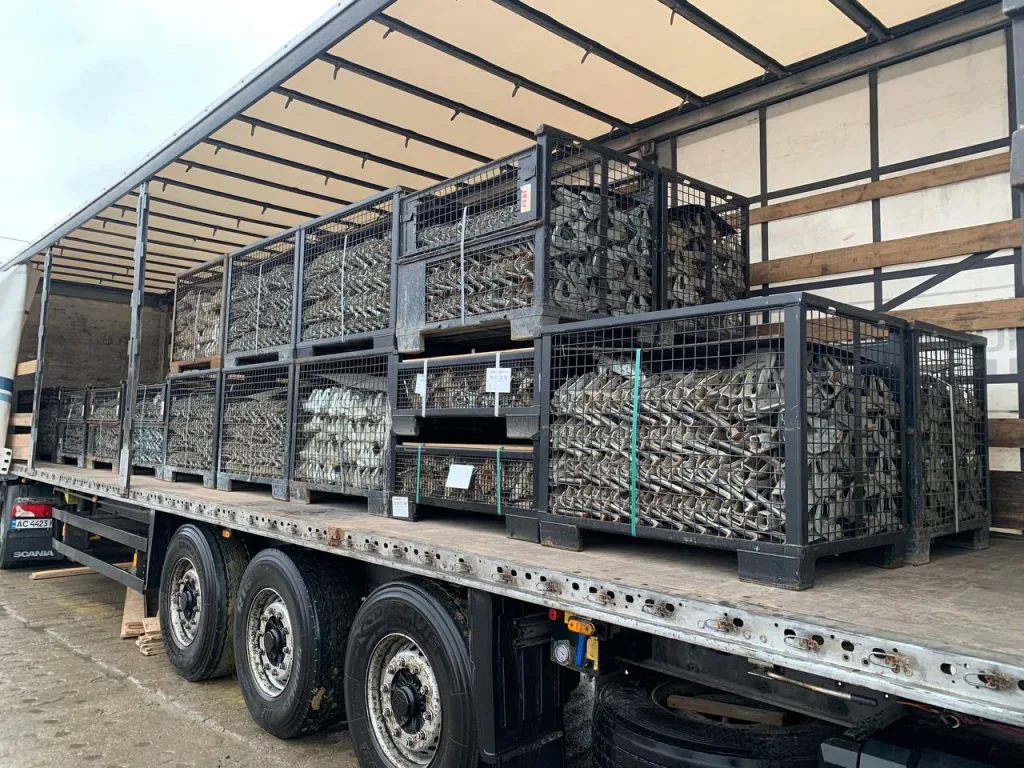
Small components (forkheads, locks, tie nuts, tie rods, clamping heads, push-pull props, front tie rods, TAR-85 crossbars, tie rods 0.85–1.00 m)
All small components must be placed in metal containers (boxes measuring 1.2 x 1.8 m), allowing them to be stacked in 2–4 layers. This makes loading convenient and safe. Small components, such as connecting locks, tie nuts, and other parts, must be secured with metal or plastic straps to prevent them from scattering during transport.
Equipment packaging formats
| Packaging format | Formwork components | Packaging Details |
|---|---|---|
| Bundles | Panels (2 m and 4 m in size—4 each; up to 1.2 m—8 each) Beams (80 each) Film faced plywood (50 sheets each) | They are stacked without additional outer packaging, placed on wooden spacers that can be immediately secured to the bottom of the stack—simplifying loading and unloading at the site—and fastened with metal straps. Stacking in two layers is permitted. |
| Pallets | Small shields (up to 1200 mm), Tripod | They are secured with metal straps. |
| Pallets | Uprights, struts, plumbing struts, brackets, diagonal braces, VDA inserts | Certified EPAL Euro pallets (80×120 cm) are used. Securing is optional. Thanks to the standardized pallet size, the equipment can be stacked in three layers when packed correctly (without loose items). |
| Boxes | Locks, tie nuts, forkheads | They are not secured with tape. |
IMPORTANT: All bundles and pallets must be secured with metal straps.
Palletizing and securing cargo
We always secure formwork panels, tripods, and other components with metal strapping. We always recommend using metal strapping, as it can withstand much heavier loads and ensures reliability during formwork transport. Although polyethylene (plastic) strapping is cheaper, it often breaks during transport, which can cause the equipment to scatter and become damaged.
Some customers use stretch film for palletizing, for example, to secure tripods. Undoubtedly, this is better than not securing the formwork elements at all. However, metal strapping remains the most reliable option, even though it is more expensive. A metal strapping machine is also an additional investment, but it guarantees the safety and integrity of the load during transport.
Another important factor in preparing formwork for transport is the process of loading the equipment directly onto the truck. At Budhub, we load and unload equipment exclusively using a forklift. This ensures:
- Speed — thanks to our mechanized process, we can get a truck ready for shipment in 30–60 minutes
- safety — the elimination of manual handling of heavy items minimizes the risk of injury to staff
- Optimal placement — the loader allows for even weight distribution inside the vehicle, which improves the stability of the cargo during transport
- Flexibility in unloading—most construction sites use top-down unloading, and we take this into account when preparing the cargo.
Next, we will look at options for assembling different types of equipment, using a standard truck as an example
The truck is 13 meters long and 2.4 meters wide; it is typically divided into four sections, each 3 to 4 meters wide.
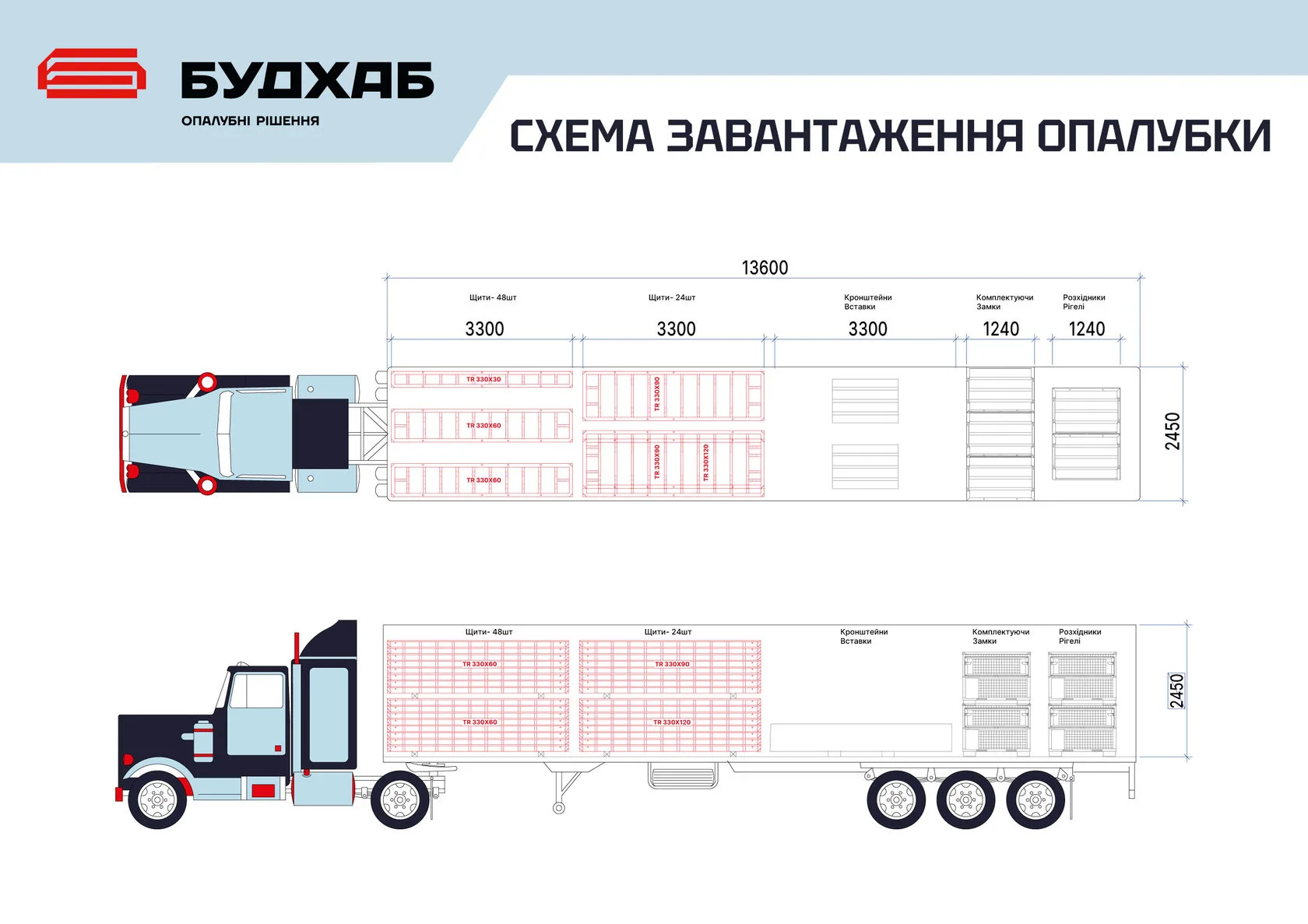
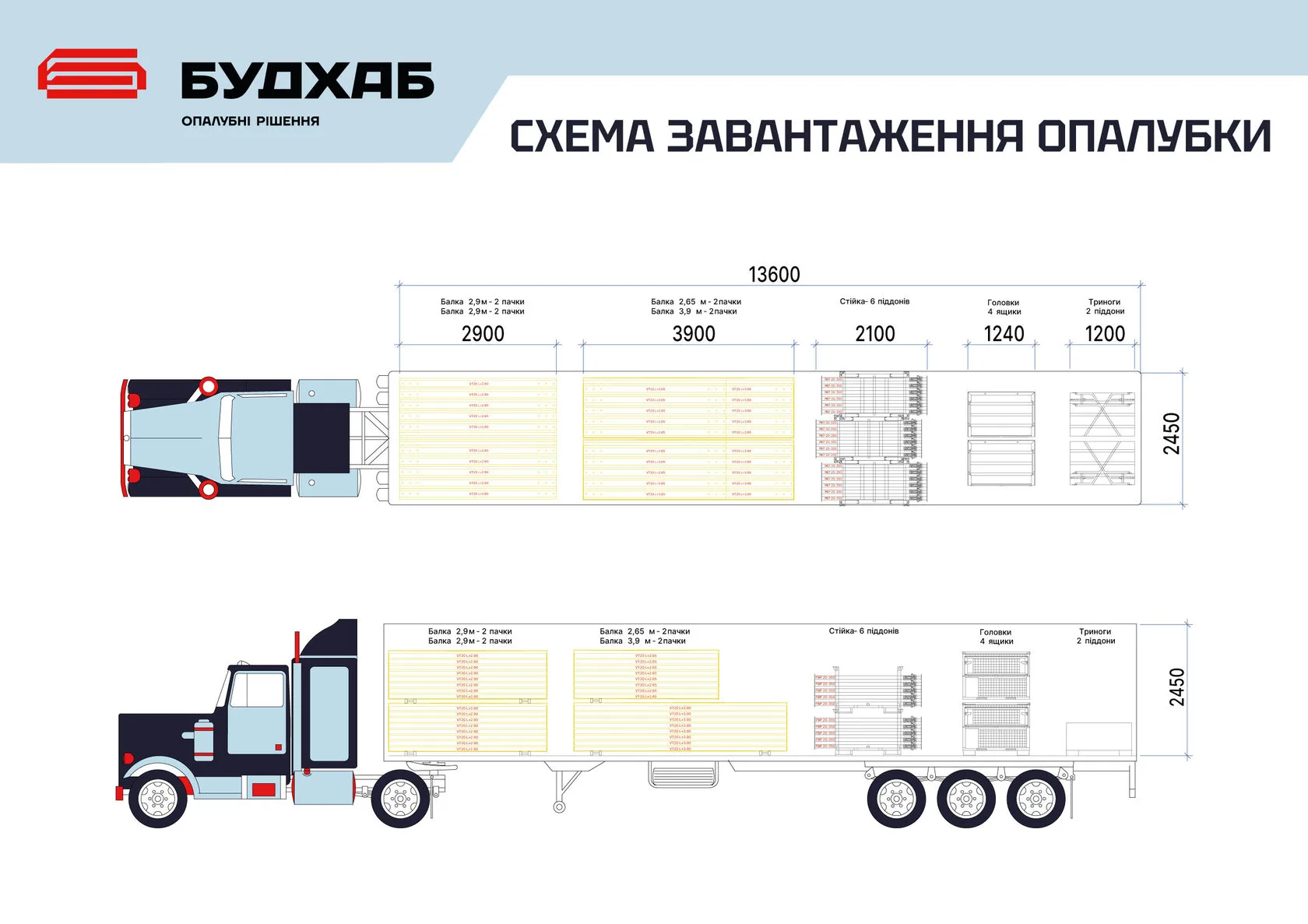
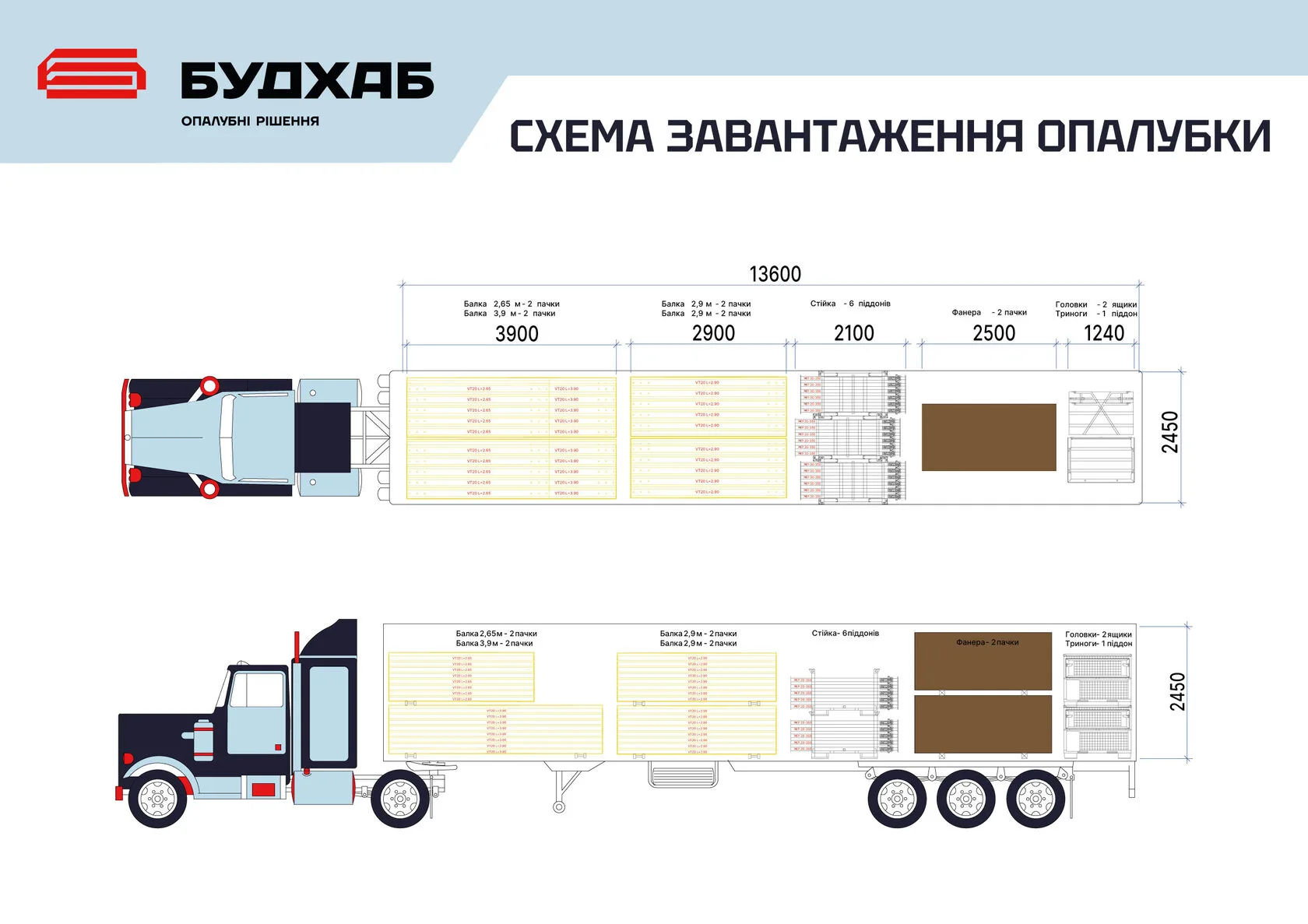
To ensure efficient loading, equipment transport, and equipment return, it is important to adhere to the principles of loading similar types of equipment, maintaining weight balance, and maximizing loading density. It is recommended to load each truck with equipment that is as uniform (identical) as possible, which will allow for efficient use of space and achieve optimal load weight (up to 20 tons).
When loading a mixed shipment (different types of equipment in a single truck), the load capacity is significantly reduced—to about 15 tons!
Among the main rules for loading equipment, we can highlight the following:
- Stack in two tiers—when assembled correctly, the equipment can be arranged in two tiers to make efficient use of space.
- Distribute the weight evenly—especially for heavy components (such as Tie nuts). Avoid concentrating heavy loads on one side of the truck.
- We balance the load—for example, if there are four bundles of panels at the front of the truck, it is best to place an equivalent amount of equipment at the rear.
All of the vehicles we use at Budhub for transporting formwork are equipped with both side and top loading capabilities, which allows us to quickly unload at any type of construction site.
We do not use dump trucks or other types of vehicles that are unsuitable for equipment transportation.
The Most Common Mistakes Made When Transporting Formwork and Their Consequences
We have already covered the rules for safe and proper storage and equipment transport. Now let’s focus on common mistakes made when loading formwork onto a truck and how to avoid them.
- Bulk storage or "pile" storage. Due to uneven loading of the truck, more trips are required for equipment return to the warehouse, which increases the risk of damage to the equipment. This type of loading makes it impossible to stack items efficiently in multiple layers and also significantly complicates unloading.
- Failure to use crossbars. The absence of a standard crossbar (100 x 80 mm) can damage the equipment stacked below and makes unloading more difficult. Crossbars also allow for the safe use of slings when unloading with a crane or forklift.
- Loading without a plan. If equipment is mixed together (for example, formwork panels, containers, and beams stacked in a haphazard manner), this leads to an unstable load and creates a hazard during equipment transport. Such an arrangement can also damage the truck’s tarp or cause items to shift during transit, which may result in damage to the formwork components.
- Using unreliable materials for palletizing. Plastic strapping can break, causing the load to fall apart. Therefore, we recommend using metal strapping or, at the very least, stretch film.
So, why is it so important to follow the rules for palletizing and transporting formwork, and how can this save you a significant amount of money in the future?
Based on our own experience, we’ve noticed that one of the biggest mistakes our clients make is that, when purchasing formwork, builders don’t buy additional metal containers in order to save money. And, as a rule, they use disposable wooden pallets or other temporary solutions that are only suitable for initial equipment transport and become unusable after just one or two uses. Later, when moving equipment on-site or performing equipment transportation between sites, the lack of proper containers leads to significant cost overruns: transportation costs increase, the risk of equipment damage during loading and unloading rises, and small parts are often lost during construction work. All of this negatively impacts the organization of the construction process and creates additional costs.
Yes, you may have noticed that high-quality metal crates for steel formwork can cost 5–10% of the total cost of the equipment set. For example, if a truckload of equipment costs 5 million UAH, the crates needed for its safe storage and equipment transport will cost 150,000–200,000 UAH.
At first glance, this may seem like a significant expense, but in the long run, it significantly reduces financial losses due to damaged or lost components. It also saves time on loading and unloading vehicles when transporting formwork.
Budhub’s rental fleet consists exclusively of equipment with containers. This allows us to predict the time required for preparing, loading, and equipment return, which significantly optimizes warehouse operations. Thanks to standardized containers, a single machine can be loaded or unloaded in 1–1.5 hours, enabling us to process up to 7–10 machines per day. Without containers, this process can take up to 4 hours per machine, causing delays and complicating logistics operations.
Thus, the use of containers is not only convenient but also a cost-effective solution for all parties involved. If the equipment is loaded in accordance with standards, its transportation and unloading take between 30 minutes and an hour. In contrast, a haphazardly loaded vehicle may require up to four hours of work and the use of additional resources.
It is worth noting that improper storage can also significantly increase transportation costs: if 15 trucks were used to deliver materials to the site, improper storage by the construction crew could require 18–20 trucks for the return trip, increasing transportation costs by 30%.
Proper transportation of formwork is not just a matter of convenience, but a critical factor in safety, cost savings, and time efficiency. Using standard loading and securing procedures significantly reduces the risk of equipment damage and streamlines logistics processes.
We hope this information has been helpful and will help you avoid any unpleasant situations during loading and equipment transportation.
If you have any further questions, please call us at:
+38 098 800 22 88