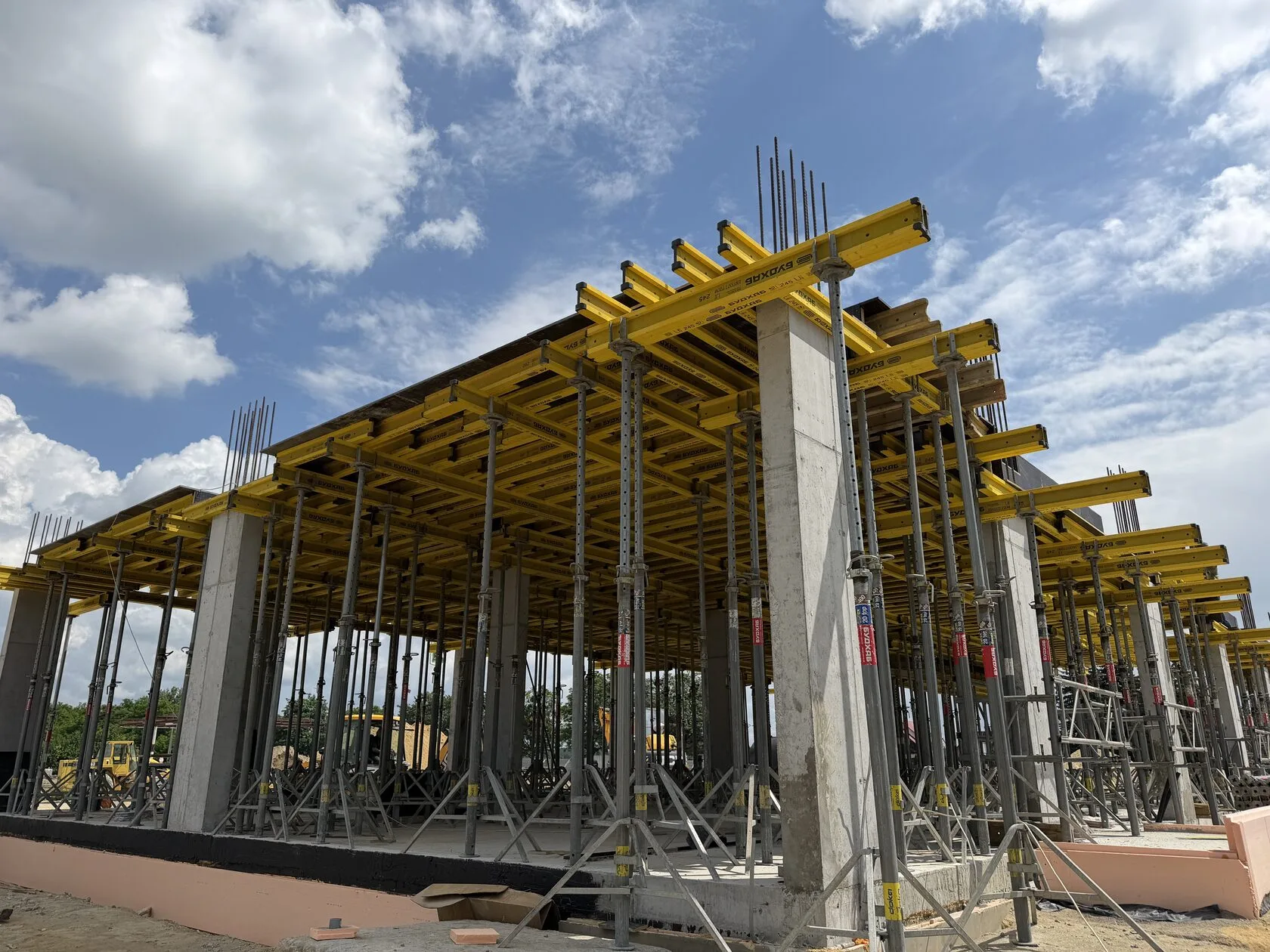
Telescopic props are the load-bearing elements of any horizontal formwork system. They bear the load from the concrete, rebar, and workers during floor slab pouring and hold the structure in its designed position until the concrete reaches its design strength.
Choosing the wrong formwork props is not a matter of budget, but of safety: improperly selected formwork props can cause the slab to deform or the formwork to collapse under load. Therefore, in this article, we’ll cover everything you need to know when selecting them: classification according to EN 1065, selecting the height, thread type, a comparison of coatings, calculating the quantity needed, compatibility with Tripods, and maintenance guidelines.
Classification of Telescopic Props
When selecting posts, the key parameter is the load-bearing capacity class according to the European standard EN 1065. The class determines the load the post can withstand at maximum overhang—it is in this position that the post is most vulnerable.
| Rack Class (according to EN 1065) | Minimum load-bearing capacity at maximum opening | Recommended Use |
| Class A | 5 – 11 kN | Balconies, cantilevers, and lightweight floor slabs in private construction |
| Class B | 10 – 14 kN | Standard residential buildings, average slab thickness |
| Class C | 15 – 17 kN | Commercial construction, parking garages, monolithic frames |
| Class D | 20 kN (at any span) | Industrial construction, heavy-duty floor slabs |
| Class E | 30 kN (at any span) | Bridges, silo pits, extra-heavy slabs (50–100 cm) |
The Budhub EU 20-300 / 20-350 props provide a stable load-bearing capacity of up to 20 kN, making them a versatile and reliable solution for most projects.
More information about rack classes:
- Class D is the standard for most structures. Pouring floor slabs up to 20 cm thick does not require additional calculations. For slabs 25–30 cm thick, Class D is also used, but only after an Engineering calculation of the spacing and number of slab props.
- Class E is a highly specialized solution. There are not many such columns on the market. They are used exclusively in combination with twice the number of beams in situations where the floor slab thickness exceeds standard limits.
- Class A is a budget option, half the price of Class D. It is suitable for floor slabs up to 20 cm thick in cottage construction, as well as for balconies and small projections. Using Class A where Class D is required is not permitted.
Manufacturers of telescopic props on the Ukrainian market
Before choosing racks based on technical specifications, it’s important to understand who’s in the market.
Global leaders—PERI, Hunnebeck (Germany), Doka (Austria), and ULMA (Spain)—are companies with decades of experience that manufacture complete formwork systems, including props.
The mid-range segment is represented by the brands Variant (Kharkiv) and Bauma (Poland). This equipment is well known to most contractors—it is widely available in rental fleets across Ukraine and meets the needs of standard construction projects.
Private-label brands manufactured in Europe — Budhub EU 20-300 / 20-350 — our own brand manufactured at European plants. Our racks comply with the EN 1065 standard, and their stated load-bearing capacity has been confirmed by independent testing using a hydraulic press.
Selecting the Height of the Posts
Telescopic props are manufactured with maximum heights ranging from 1.5 to 5.5 m in 0.5 m increments. The number in the model designation indicates the maximum height when the prop is fully extended. The 3.5-meter stand can be used at any height below the maximum—the telescopic prop allows for precise adjustment.
The choice of a specific model is determined solely by the design floor height at the site.
Open or closed thread
The type of thread directly affects the reliability and ease of maintenance of the rack on a construction site.
Sealed thread: The mechanism is protected by a sleeve that prevents concrete slurry from entering directly. In practice, if the slurry does manage to get inside, it is nearly impossible to clean the assembly. The result is thread jamming and premature failure of the support.
Exposed thread: The threaded element is located on the outside; it is cleaned mechanically or chemically and can be easily lubricated before the next cycle. This is the type used in European-style equipment—it preserves the integrity of the outer pipe’s cross-section and ensures stable operation of the assembly under the design load.
On Budhub EU stands, the threads are rolled directly onto the outer tube—without a weld in the adjustment area. This design ensures that the tube retains its full strength precisely where the load is greatest.
Paint or Zinc: Which to Choose
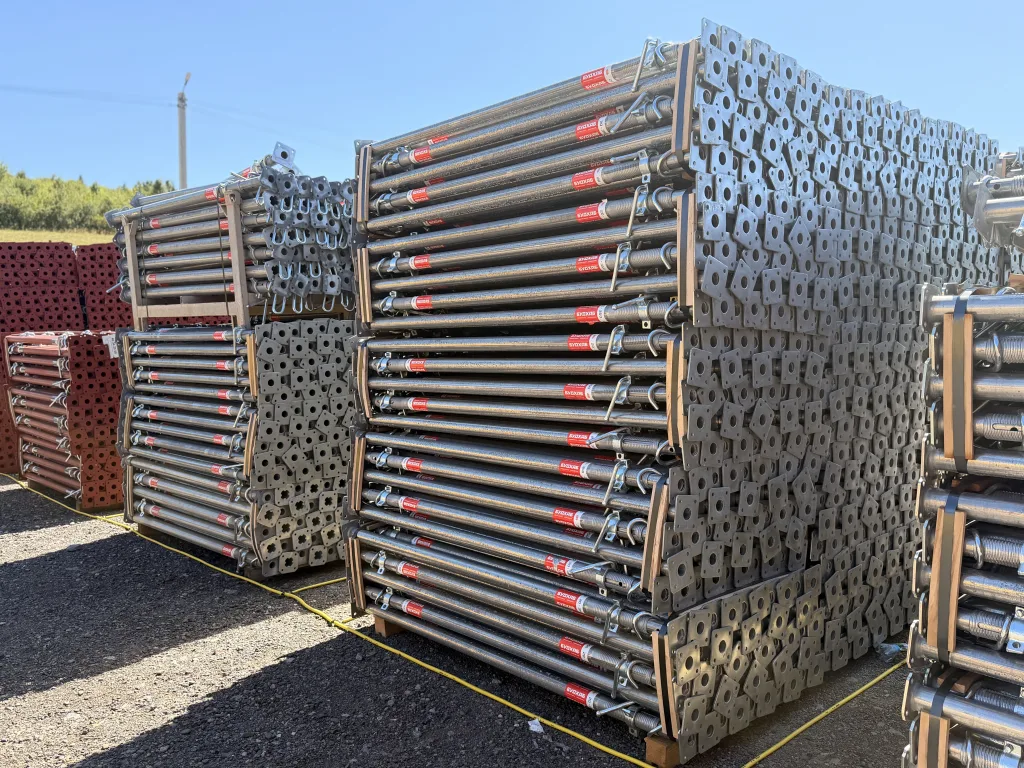
At Budhub, we manufacture racks at European factories under our own brand and offer two protective coating options that meet requirements for service life and budget: painted and galvanized.
Galvanized formwork props are more expensive but the most reliable. Under the right operating conditions, some models can last up to 36 years. It’s a good idea to choose them when renting formwork or if you already have significant experience working with concrete.
Painted formwork posts are a more budget-friendly yet effective solution. They can withstand the same workloads but have a shorter service life compared to galvanized ones. This is the optimal choice for construction companies that are just building up their formwork fleet, optimizing initial costs, or performing monolithic work on a non-regular basis. Thanks to their lower cost, they allow you to equip a job site without excessive capital investment, achieve the necessary load-bearing capacity, and quickly recoup your investment.
| Description | Budhub EU 20-300 / 20-350 Stands (Paint) | Budhub EU 20-300 / 20-350 Posts (Zinc) |
| Working Height | 3.0 m; 3.5 m | 3.0 m; 3.5 m |
| Load-bearing capacity | up to 20 kN | up to 20 kN |
| Material | steel | steel |
| Thread | open | open |
| Tie nut | forged, high-strength | forged, high-strength |
| Labeling | takeoff and maximum payload | takeoff and maximum payload |
| Mass | 12 kg; 14.5 kg | 14 kg; 15.5 kg |
| Coating | paint | hot-dip galvanizing |
| Additional protection | missing | Re-galvanizing a weld |
Calculation: How many posts are needed per 1 m²?
A common question is: exactly how many slab props are needed to pour a floor slab? For example, for a standard slab 200 mm thick (where 1 m² of concrete weighs about 500 kg), an average of 1 to 1.2 slab props per 1 m² is used.
However, this figure is approximate. The spacing between the posts depends on the spacing of the main and secondary beams (I-beams), the thickness of the plywood, and the load-bearing capacity of the post itself.
Never set up the formwork props “by eye.” We emphasize the need for precise engineering calculations. Only a professionally laid-out slab formwork system guarantees worker safety and a level floor slab without sagging.
How to Check if a Tripod Is Compatible with Stands
Tripods ensure the vertical stability of the supports during installation (until the joists and plywood are laid). If you are renting or purchasing supports but have your own tripods, be sure to check that they are compatible.
Standard tripods are generally versatile and compatible with most telescopic props. However, the tripod’s clamp must always fit snugly around the outer tube to ensure a secure hold and safety during assembly.
Special reinforced tripods are required for tall masts (5 and 5.5 m). Because the outer pipe diameter on these masts is larger, a standard tripod simply won’t be able to grip it, which will complicate installation and create a hazard on site.
Inspection of the condition of the posts before installation
Before each formwork installation, the foreman in charge must conduct a visual inspection of the equipment. It is important to check:
- The absence of bends and deformations in the pipes (a bent support loses its load-bearing capacity).
- Condition of the exposed thread (it must be clean, and the tie nut must turn freely).
- The presence of a fastener (pin/clamp) that secures the inner tube.
Transportation, Packaging, and Cleaning
Proper logistics and maintenance directly affect the equipment’s lifespan.
How to pack for transport: The props must be transported in special metal crates (pallets) in a horizontal position, securely strapped with metal or sturdy plastic straps to prevent the pipes from rolling around in the cargo area. For more information on Logistics, see here: Formwork Transportation Guidelines.
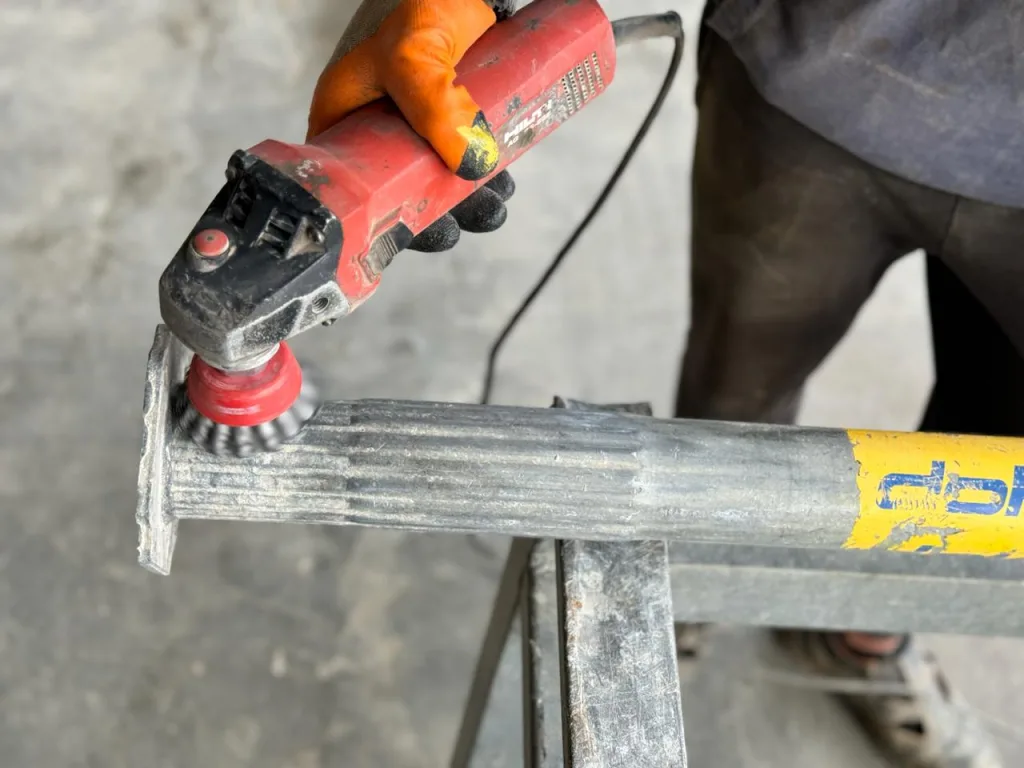
How to clean: After removing the support, clean off any caked-on concrete (pay special attention to the threads) using power tools or special cleaning agents. The threads and the forged tie nut should be lubricated before the next use. For more details on care and transportation guidelines, see our article.
Crash test of Budhub posts under laboratory conditions
We don’t just talk about the reliability of our equipment—we put it to the test. Budhub-brand painted and galvanized posts have undergone rigorous crash testing under a hydraulic press in independent laboratory conditions. The testing confirmed the claimed load-bearing capacity and demonstrated the behavior of PROF S275 IOH steel under critical loads.
Watch the test video at the link.
Are you looking for formwork props?
We’ll help you choose the best option for your project, calculate the number of racks you’ll need, and, if necessary, arrange for delivery, returns, cleaning, and repairs.
If you need advice or help with putting together a package, please call the following number:
+38 098 800 22 88