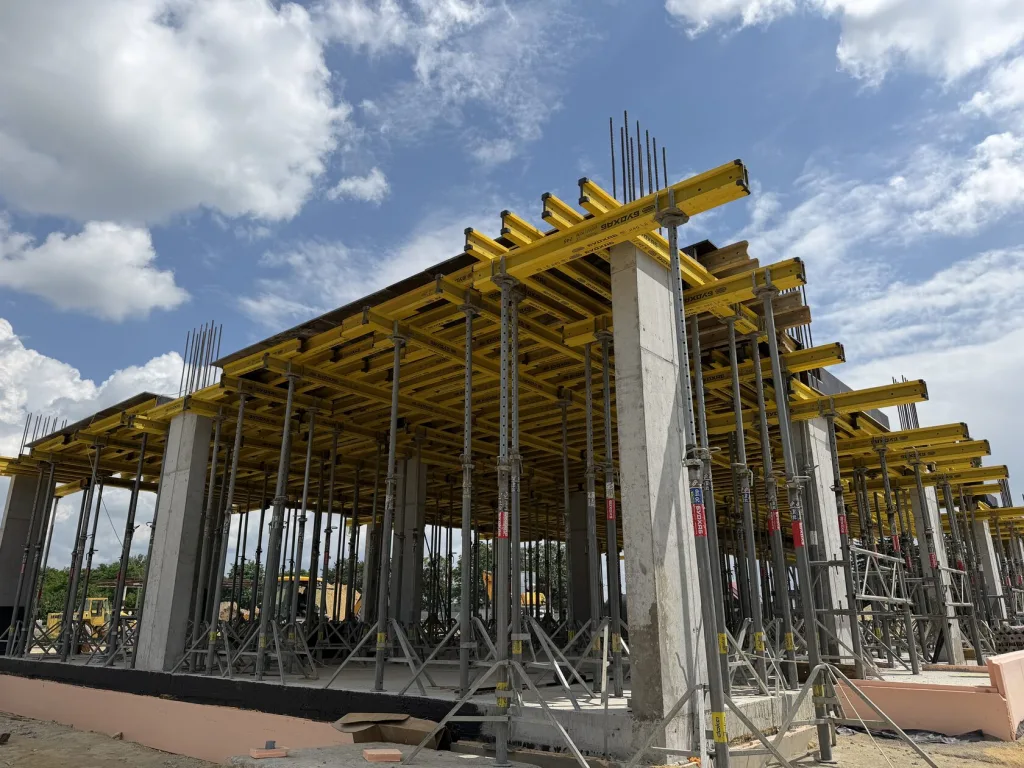
In monolithic construction, there are currently several approaches to assembling horizontal formwork: some systems involve the use of timber or composite beams and plywood, while others use formwork panels or cassettes. Given that the slab formwork option using beams and plywood is more popular on the Ukrainian market, in this article we will examine the different types of beams available, the differences between them, and what factors affect their service life.
At first glance, a formwork beam seems like a fairly simple component—a wooden piece that supports the formwork system. But in reality, it plays a key role in the formation of floor slabs: the plywood rests on it, it bears the load of the concrete, and it ensures the structural rigidity and geometric stability of the structure. If the beam deforms or deviates from the specified geometry, the entire formwork system suffers.
Therefore, it is important to understand what it consists of and which of its characteristics affect its service life, load capacity, and safety at the facility.
Beam design
A formwork beam is a technically sophisticated component that ensures the rigidity and stability of the floor slab. I-beams are most commonly used, as their shape allows for even load distribution and minimizes deflection during concrete pouring.
This type of beam has two horizontal sections—top and bottom—with a vertical web between them. Together, these form a shape resembling the letter “H”—the so-called I-beam. The top and bottom sections, or flanges, are usually made of strong softwood—they bear the bending load and ensure overall stability.
Between them is a web, which determines the beam’s stiffness and its resistance to repeated loads, moisture, and deformation. The choice of web material determines how long the beam will last and how it will perform in real-world construction conditions.
To a large extent, it is the type of flange that determines the weight of the beam, its durability, and ease of use. Most often, manufacturers use one of two options: three-ply plywood or particleboard.
There is no single right answer when choosing between a wooden slat and particleboard.
Some believe that three-ply plywood is lighter and cheaper than particleboard, but when it comes to which material is more moisture-resistant, has a longer service life, and retains its shape better, expert opinions differ.
Do you have experience working with different types of ribs? Share your insights.
Variations in height and stiffness
Formwork beams differ not only in material but also in size and rigidity. These characteristics are selected based on the construction conditions: the type of floor slabs to be built, the loads the system must withstand, and the number of people working on the construction site.
In most cases, construction sites use standard 200×80 mm beams. This is a convenient and versatile option: such beams are compatible with various types of formwork, are easy to install by hand, and are lightweight enough for easy transport. They are used in both residential and industrial construction.
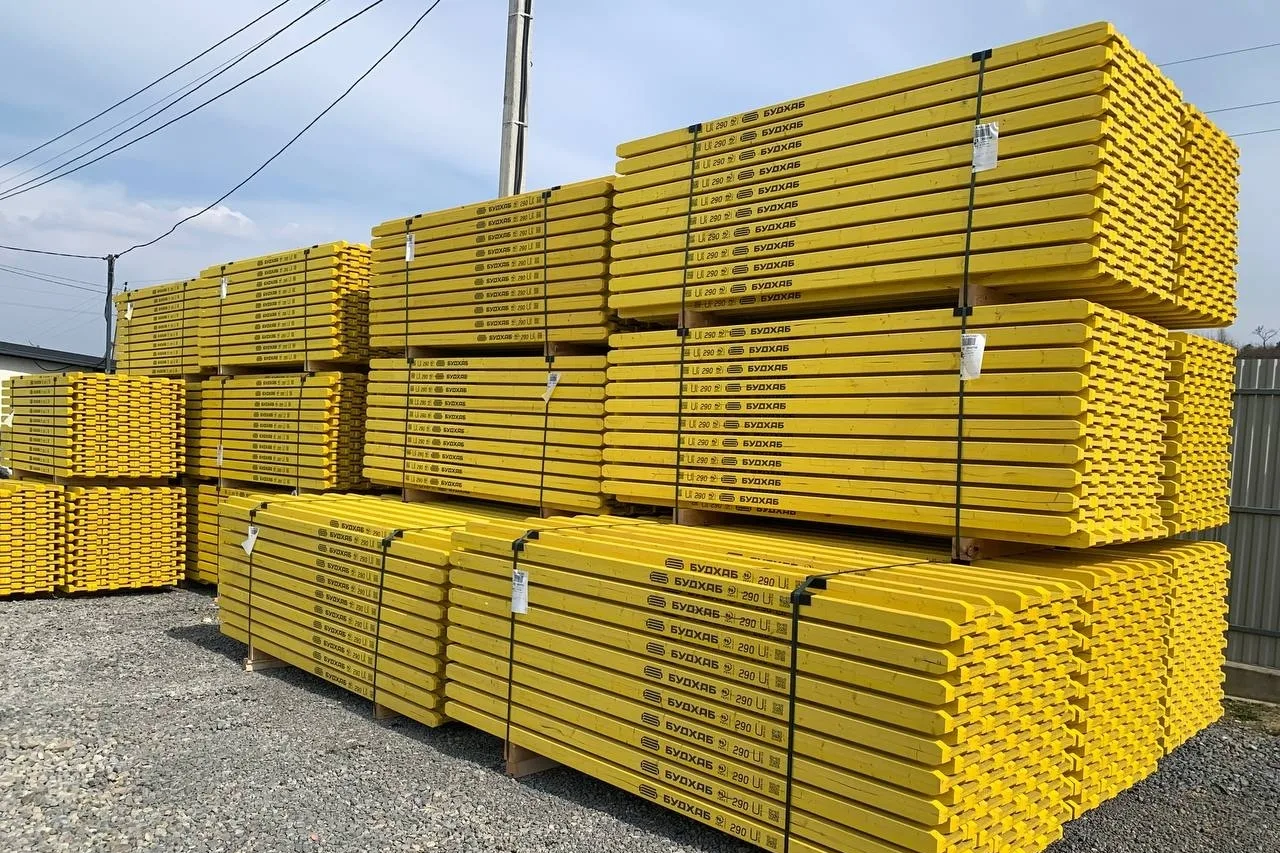
A standard floor beam is 200 mm high and has a flange width of 80 mm—hence the common designation 200×80 mm. The length can vary depending on requirements: 1.45 m, 2.15 m, 2.45 m, 2.65 m, 2.90 m, 3.30 m, 3.60 m, 3.90 m, 4.50 m.
If, however, you need to span large openings, work with thick slabs, or anticipate heavy loads, reinforced beams are the better choice. They are taller, have a stiffer web, or are made of composite materials—such as wood reinforced with polymers. Such beams are more difficult to transport and are significantly more expensive, which is why they are used less frequently in Ukraine. However, on complex projects, they fully live up to expectations.
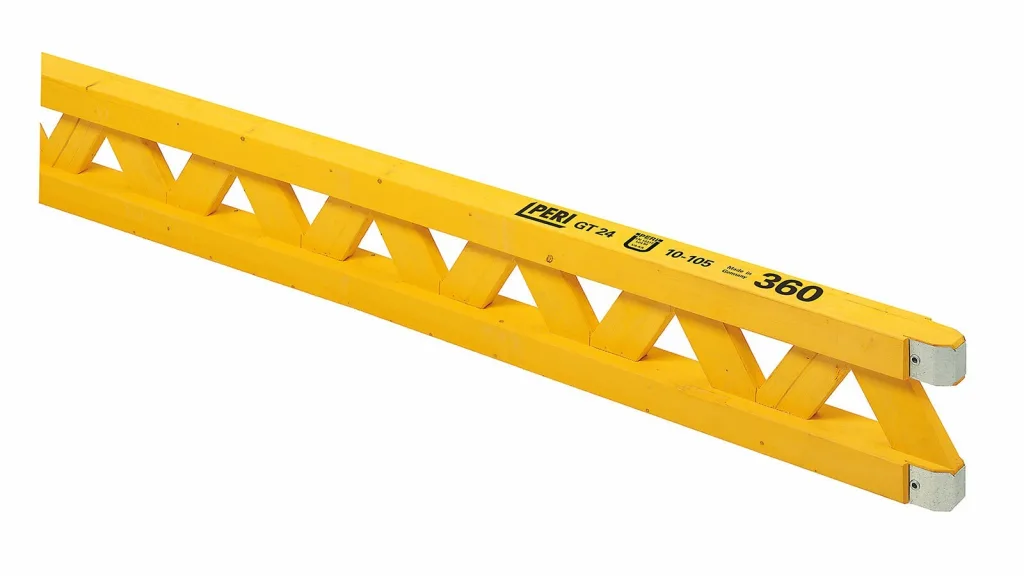
For example, PERI offers the GT-24 model—a 24-centimeter-high beam featuring a “truss” instead of a solid web. These beams can withstand extremely high loads and are used on sites where concrete exerts significant pressure. However, they are rarely used in Ukraine due to their high cost and logistical challenges.
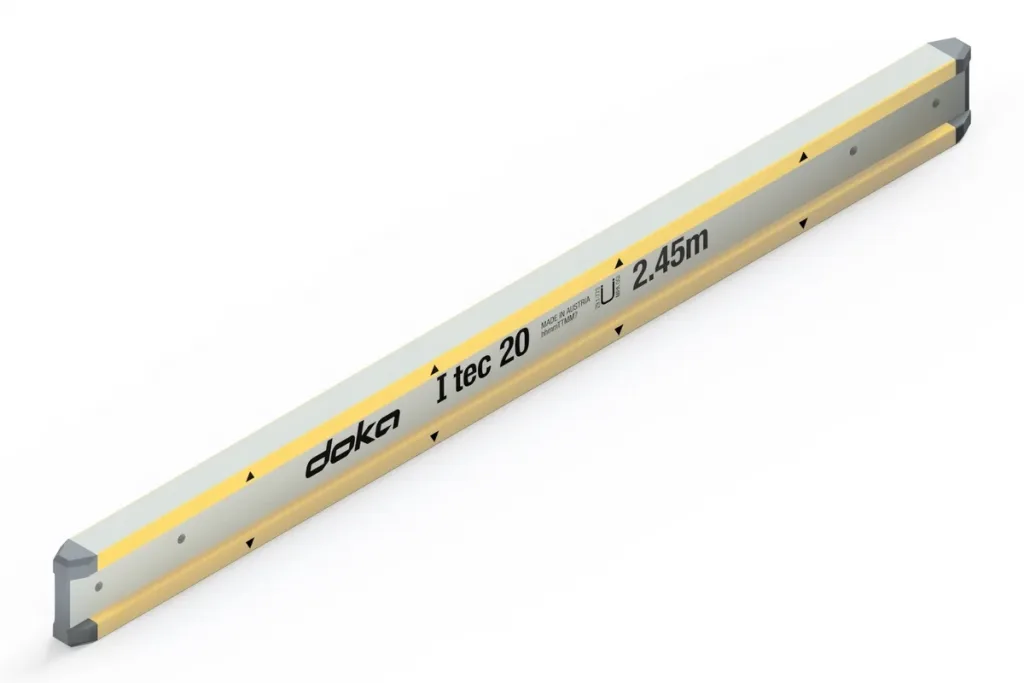
By the way, Doka has a counterpart—the I tec 20 beam. This is a 20-centimeter-high composite I-beam that combines wood and polymers for enhanced strength and durability. The beam is designed for use in formwork systems that require high load-bearing capacity and a long service life.
Materials and manufacturing processes
The strongest beams are made from softwood that has grown under favorable natural conditions—typically in the mountains, where trees grow more slowly, developing dense fibers, consistent moisture content, and even annual rings. All of these factors directly influence the strength and stability of the wood under load.
To make the beam more resistant to moisture, UV radiation, and abrasion, its surface is coated with a yellow melamine layer. This is not just a distinctive color, but a protective coating that helps the beam retain its shape longer, prevents it from drying out, and enables it to better withstand harsh operating conditions.
By the way, the appearance also speaks to quality: if you look closely at a cross-section, you can see uniform growth rings, the absence of large knots and chips, and a consistent wood grain—all of which indicate strict quality control at every stage of production, from raw material selection to the finished product.
Another important aspect is the internal structure. Most beams are not made from a single piece of wood but using a gluing process, which allows for high precision and consistent geometry—something that is difficult to achieve when working with solid wood. The joints in such beams are always spaced along their length to avoid creating weak spots. And the use of moisture-resistant adhesives and hot pressing ensures that the beam retains its properties even after dozens of installation and removal cycles.
End caps
Ends are one of the most vulnerable parts of a timber beam. They are often the ones that bear the brunt of the impact during careless dismantling, transport, or a fall. Imagine this: a 1-meter beam weighs an average of about 5 kg. If the length is 3 meters, that’s already 15 kg of wood that could fall from a height. And at the moment of impact, the end face is the first to suffer.
Keep in mind: a damaged end isn’t a reason to discard the beam. If it has a small crack, you can always trim the edge, sand it down, or touch it up with paint.
However, if there are many such damages, the risk of moisture penetrating the wood increases. And this poses a real threat to the beam’s service life: the material will begin to lose its shape, and warping and weakening will occur at the support points. This is particularly important to consider when the beam is used in rental properties or at high-traffic sites, where each cycle of installation and removal creates additional risks of damage.
The most common method of protection is plastic end caps, which serve a basic function: they cover the end of the pipe to prevent mechanical damage and protect it from direct contact with moisture. This type of protection is perfectly suitable for typical projects with a slow construction pace.
When increased reliability is required—for example, at large facilities or during frequent equipment transport—it is best to opt for metal liners. They are significantly more durable, withstand impacts well, and do not wear out over time. This solution helps minimize equipment loss even under heavy use. Such liners are often used in systems designed for long-term use.
The most expensive, but also the most effective option is to fill the ends with a soft polymer. In this case, the beam end is literally “encased” in a flexible, shock-absorbing layer that dampens impacts and prevents the wood from splitting. This type of protection is recommended for sites with a high pace of work, frequent equipment movement, or in conditions where there is no control over the careful handling of the beam.
Not all beams have protected ends—and this is also a perfectly acceptable design option. In this case, the end remains open, without any plastic or metal components. Such a beam is in no way inferior in terms of its performance: it can withstand the same loads, functions within the formwork system, and can be reused multiple times.
At the same time, the exposed end requires more careful handling: it is important not to drop the beam, not to strike the end against a hard surface, and to avoid prolonged exposure to moisture. None of this is critical, but it does affect the beam’s appearance and durability.
If the equipment is stored properly, transported correctly, and operated under controlled conditions, an open-ended beam can also provide long-lasting and reliable service. It all depends on how it is used.
Storage and Shipping Conditions
The quality of a beam also depends on how it is handled at the construction site. Even the strongest structure loses its properties if it is stored or transported improperly, so it is important to follow these simple but critical rules.
1. Horizontal storage with spacers
To ensure that the beam retains its shape and remains usable for many cycles, it is important to stack it properly. The best method is to stack them horizontally in several layers, always with wooden spacers between the layers. This ensures ventilation and even weight distribution, preventing warping or moisture buildup between the layers.
2. Avoiding Moisture and Point Loads
Never store beams directly on the ground or on concrete—moisture from below quickly penetrates the wood, even through a protective coating. Beams should rest on a dry, elevated surface. It is also important to avoid situations where part of the beam hangs unsupported—this creates a point load that can cause the wood to warp or crack.
3. Advantages of “in-use”
storage The best place to store a beam is not in a warehouse, but in formwork. When a beam is installed in a system, it is well-ventilated, is not exposed to a damp environment, and is not compressed by other elements. In fact, most damage occurs not during use, but specifically during storage and transportation. Beams that are constantly “in use” are usually in better condition than those that sit in a corner of a warehouse for months.
For more information on the specifics of formwork equipment transport, read our article “Formwork Equipment Transport: How Proper Storage Minimizes Risks and Additional Costs.”
Service life and durability
To ensure a beam lasts a long time, it is important not only to store it properly but also to use it wisely on the job, because even the strongest structure will wear out faster if it is overloaded or thrown on the ground after dismantling. On the other hand, a standard beam can withstand dozens of cycles if handled with care.
A beam’s service life depends not only on the material but also on how it is handled on-site, so it is important to consider the following points:
1. Load and Number of Pouring
Cycles On average, a high-quality beam can withstand between 40 and 70 pouring cycles. This depends not only on the manufacturer but also on the conditions under which it operates. If the load is within normal limits, the beam is not overloaded and functions as intended—it can last significantly longer.
2. The Impact of Damage and Proper Handling
It is not concrete that causes the most damage to the beam, but human factors: drops, impacts, being thrown to the ground, storage in damp conditions, and haphazard stacking.
Practical tips for extending the service life
- Store the beams in a dry room, not on the ground or concrete.
- Use separators (spacers) between the layers.
- Don't overload it—if the structure needs reinforcing, it's better to add another beam than to take a risk.
- Avoid dropping items during disassembly—this is the most common cause of damage.
- Check the condition of the ends—trim, touch up, or sand them as needed
And most importantly: treat the beam as a tool, not a consumable, and it will last its full lifespan.
We hope you found this article helpful and that it gave you a better understanding of what a formwork beam is made of, how it functions in a Horizontal formwork system, and why its service life depends not only on the manufacturer and the materials used in its construction, but also on the operating conditions at the construction site.
At Budhub, we’re always ready to help you find the right beam for your needs. So if you have any questions or need advice, please don’t hesitate to reach out—we’re always here to help.
+38 098 800 22 88