Have you ever had the feeling that there’s plenty of equipment on site, only to find that a few racks are actually missing in a critical location? Or, conversely, that a bunch of components remain unpacked? And what about those times when a slab suddenly sags, even though “we’ve poured it a hundred times before and everything was fine”?
Most people who work with formwork are familiar with situations like this, and the root of the problem lies in the lack of professional engineering calculations.
That is why we will now explain why engineering support is just as important as the formwork itself, and how proper engineering calculations help avoid unnecessary costs and risks on the construction site.
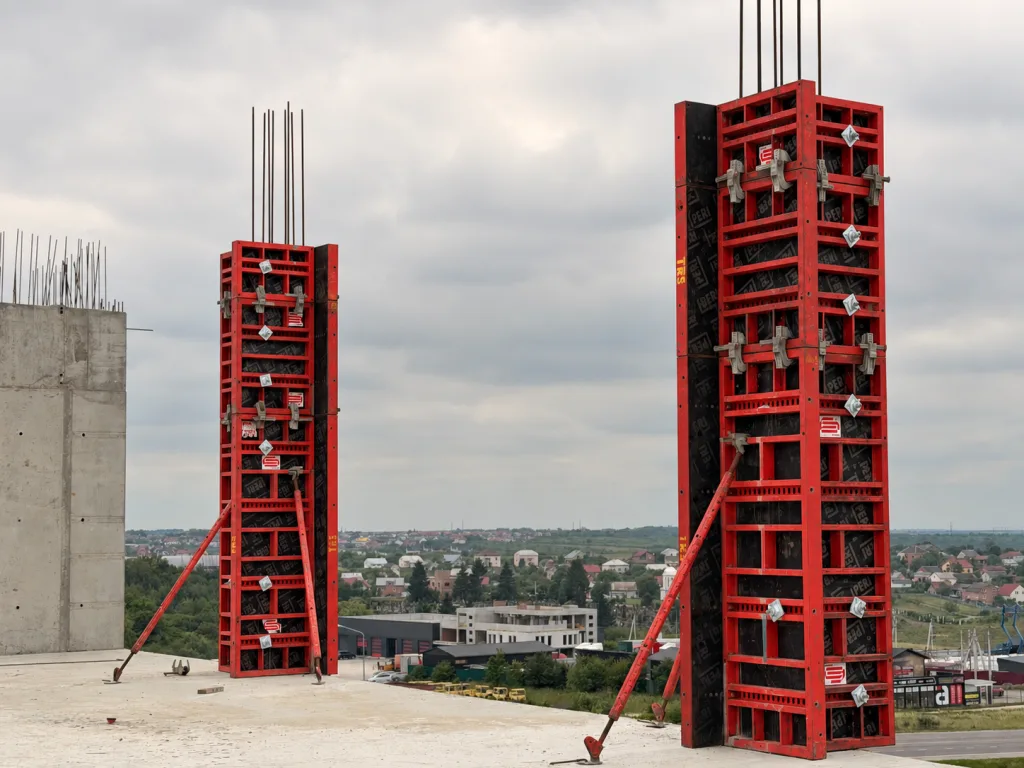
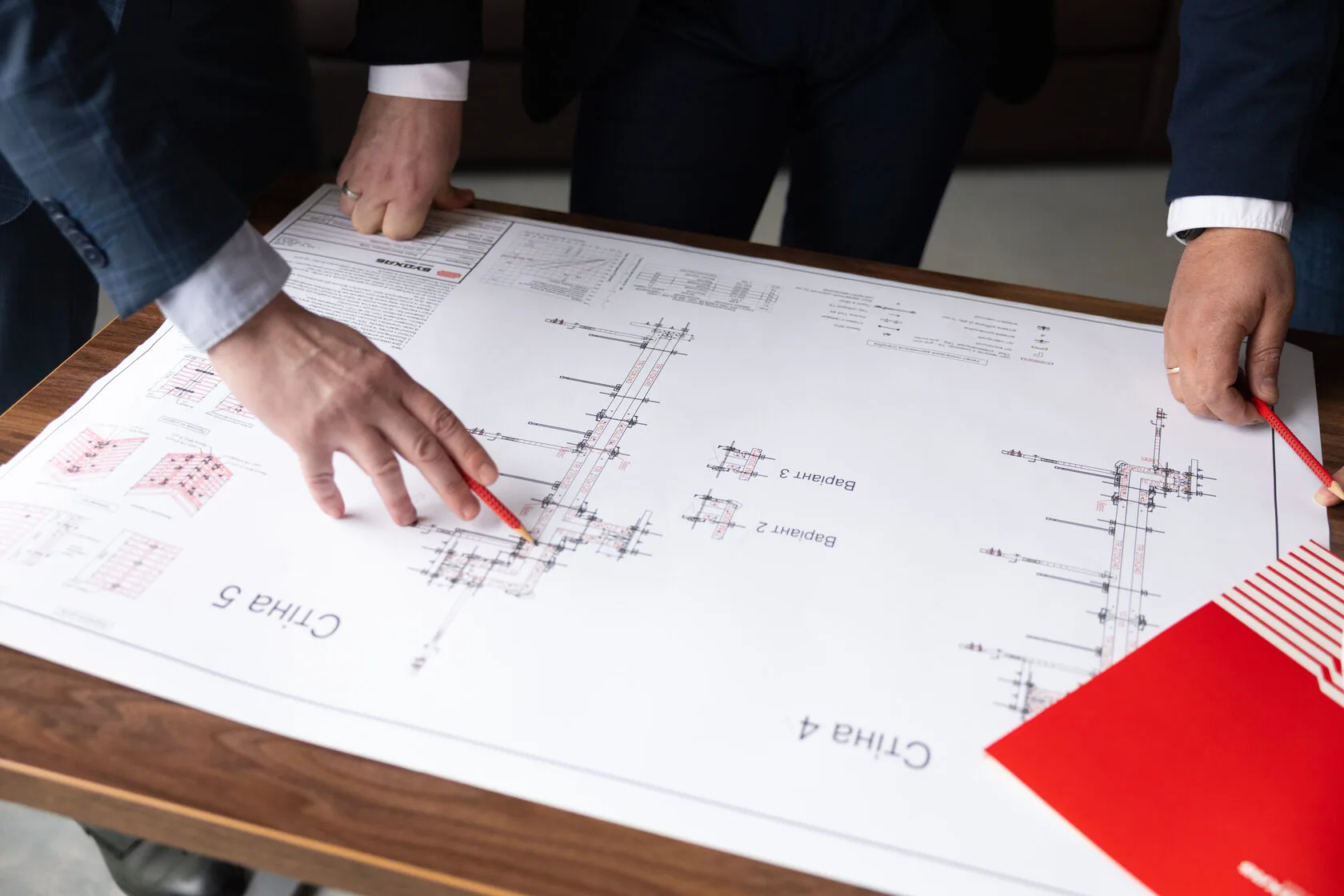
Engineering calculations are the foundation of safety and cost-effectiveness for any formwork project. It is necessary to accurately determine exactly how many panels, beams, props, and components are needed on-site, as well as where and how to position them correctly so that the formwork can withstand all loads during concrete pouring.
The calculation takes into account many factors: the weight of the structures, the types of components, the thickness of walls or Floor slabs, permissible deflections and overhangs, as well as the weather conditions and climate in which the structure is being built.
The Importance of Engineering Calculations
Engineering solutions directly impact the cost, timeline, and safety of your project. And if you proceed without precise technical solutions, the risks increase significantly.
- Overspending on equipment. Builders often install more posts, panels, and beams than necessary just to be on the safe side. This automatically increases costs by 30–40% and ties up your funds in equipment that isn’t actually being used on the job site.
- Risk of collapse or deformation. If the concrete pressure and the load-bearing capacity of the structural elements are calculated incorrectly, this can lead to sagging slabs, wall deflections, and, in the worst case, the collapse of part of the formwork.
- Downtime and delays. Errors in determining the required amount of equipment lead to work stoppages, urgent reorders, and delays in project completion.
- Damage to reputation. Correcting mistakes during the concrete work phase is very costly. But losing the trust of a client or customer is even more costly.
Accurate engineering calculations enable safe construction, optimal use of equipment, control of costs at every stage of the project, and ensure high-quality monolithic structures without the need for rework.
In this process, engineering support is not just an additional service, but an integral part of your construction strategy—a tool that helps you avoid chaos and unexpected costs while maintaining project stability at every stage.
We invite you to consider some typical scenarios in which proper formwork layout affects the cost, pace, and quality of project implementation.
Residential property with an area of 1,000 m²
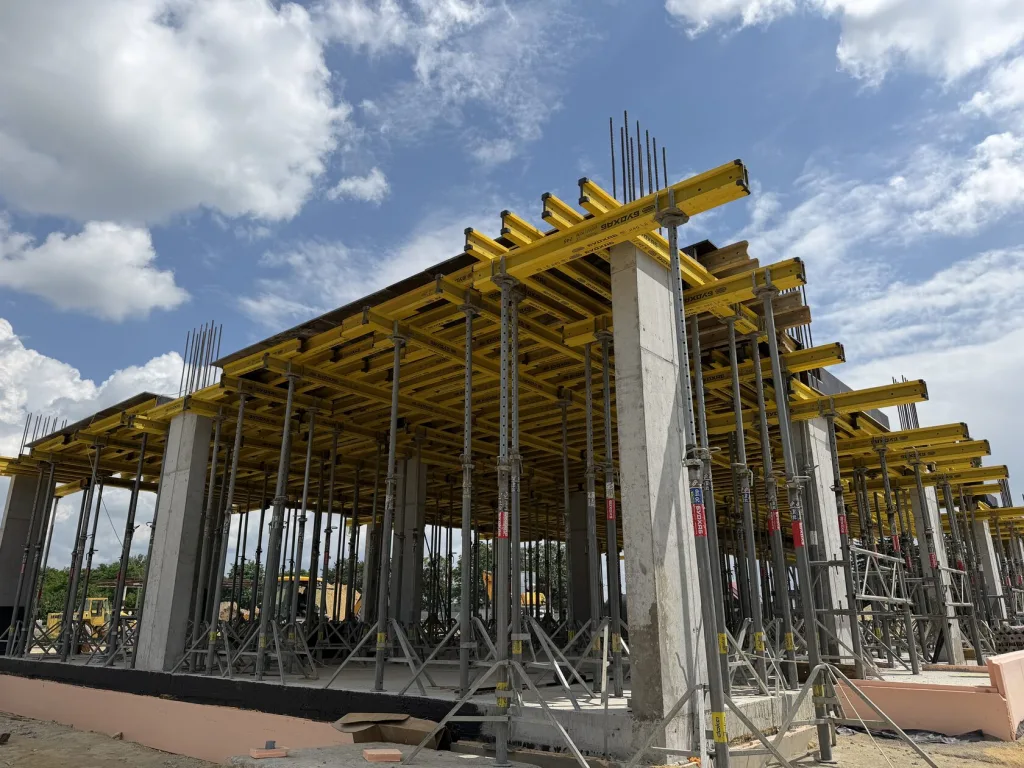
For a residential project requiring approximately 1,000 m² of slab formwork, a crew working without engineering supervision typically installs 750 formwork props in the horizontal formwork. After engineers laid out the slab formwork, taking into account all specifications and loads required for the specific structure, the number of slab props for this project was reduced to 500–550. And that’s a savings of up to 40%! If a set costs 4 million to purchase, this means that without proper calculations, you could end up spending an additional 1–1.5 million UAH.
Industrial and commercial facilities
In commercial or industrial construction, engineering calculation is not an option but a necessity. For example, with a floor height of 5 m and increased thickness of the floor slab, the load on the columns increases significantly, and if they are installed as in standard residential buildings, there is a risk not only of slab sagging but also of deformation of the entire system.
An experienced engineer knows that for such tasks, it is necessary to account for overhangs, supports, bending points, and reinforcements at joints and corners. If this is not done, the structure may deflect by 1–3 cm.
Structures at heights or with increased loads require special attention. In such cases, safety elements must be included in the calculations—for example, the use of special brackets for working at heights. Brackets allow for the proper securing of work platforms, provide guardrails on slabs or walls, and ensure the safe movement of workers at the pouring level. This is not merely an addition to the main structure but a crucial part of the project that minimizes the risks of falls and injuries.
One such facility is a fish processing plant. You can find out more here.
If you are working on a project for a shopping center, sports facility, or industrial complex, you cannot limit yourself to simply selecting equipment based on size or quantity. Here, an engineering solution tailored to each specific task is essential. Otherwise, even a minor error or the absence of basic safety measures can end up costing much more than it seemed at the initial cost-saving stage.
Why it’s important to choose a company with an engineering department
When it comes to formwork, it’s not enough to simply acquire the equipment—even if it’s high-quality and new. The key question is how exactly that equipment will be used on-site. That’s why it’s so important to work with a company that has its own engineering department.
A supplier with its own engineering department takes responsibility not only for delivering the formwork but also for ensuring that it operates efficiently, safely, and cost-effectively at your site. Even during the site preparation phase, engineers calculate the optimal number of panels, props, and components, select the correct types of fasteners, and take into account loads, concrete pouring plans, complex assemblies, and the climatic conditions in which the site will be built.
Having an engineering department within the company ensures that:
- The calculation will not be done "by eye," but will be based on technical standards, actual loads, and extensive experience working on similar projects
- You will receive not just a set of equipment, but a turnkey technical solution tailored to your facility
- The installation process will be streamlined, and costs will be kept under control
- All safety requirements (guardrails, brackets, platforms) will be taken into account during the planning phase, rather than after mistakes have been made on-site.
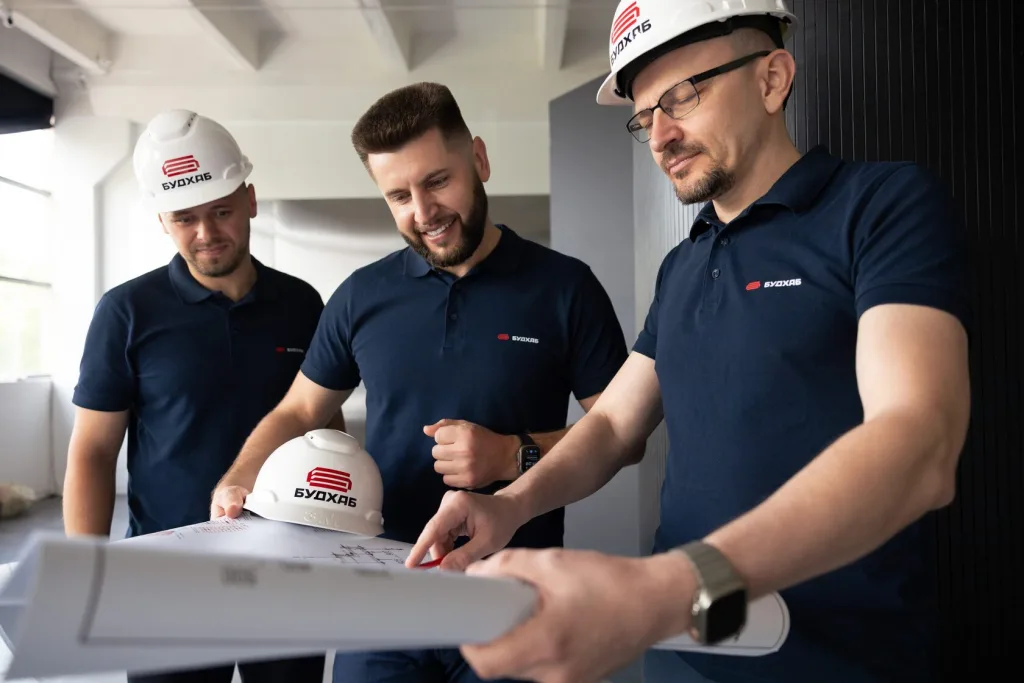
When you choose a company with an engineering department, you’re essentially gaining a partner who will guide your project from the design phase through to the completion of concrete work. This minimizes risks and gives you confidence that every hryvnia invested is working toward the result, rather than being wasted on additional costs and fixing mistakes.
Budhub’s clients always rely on and trust our qualified engineers, who design everything from residential buildings to complex, non-standard structures, such as silo pits or large industrial complexes. These include commercial halls with ceiling heights of 5–10 m and shelters with walls 0.5 m, 0.8 m, 1 m, or more than 1 m thick. After all, in such cases, it is important to consider all the details: where to place the plumbing struts, how to secure the formwork panels, and which elements to use to reinforce the corners. That is why our team implements only those solutions recommended by the formwork manufacturer and, of course, based on experience gained over the years.
We hope that the presence of an engineering department will now be a key factor for you when choosing a formwork supplier. After all, having the right equipment is only half the battle; without proper planning and a logical approach to its use, it won’t perform to its full potential.
If you already have a specific request or project, or if you have any questions, please call us at +38 098 800 22 88 or submit a request on our website.