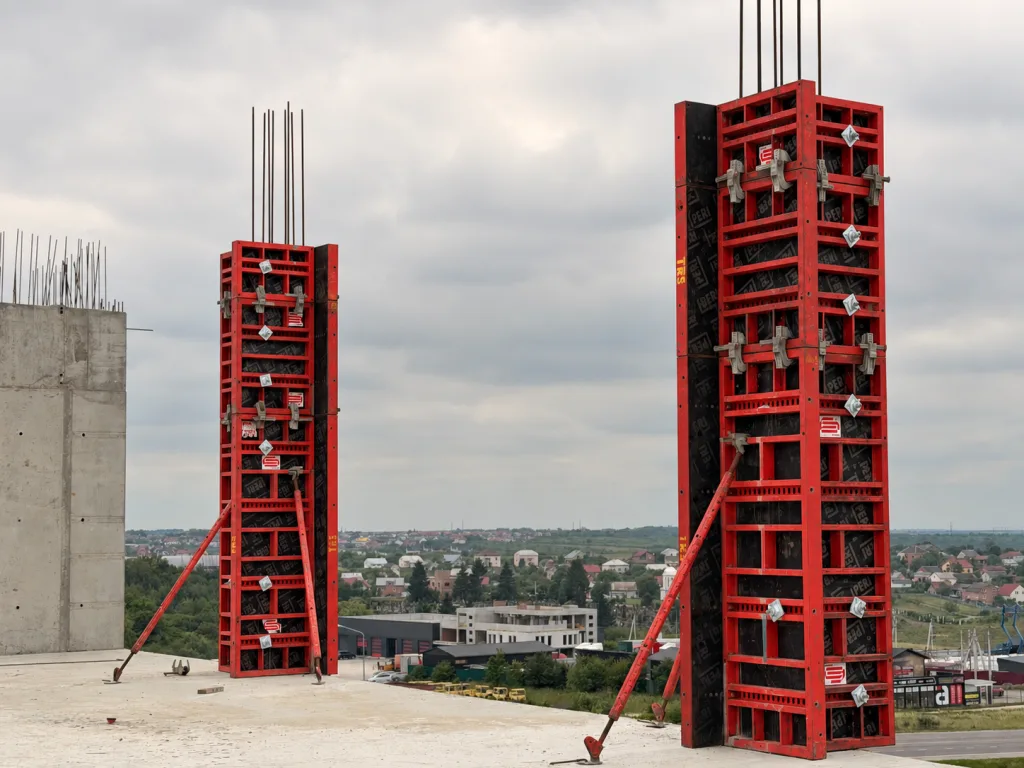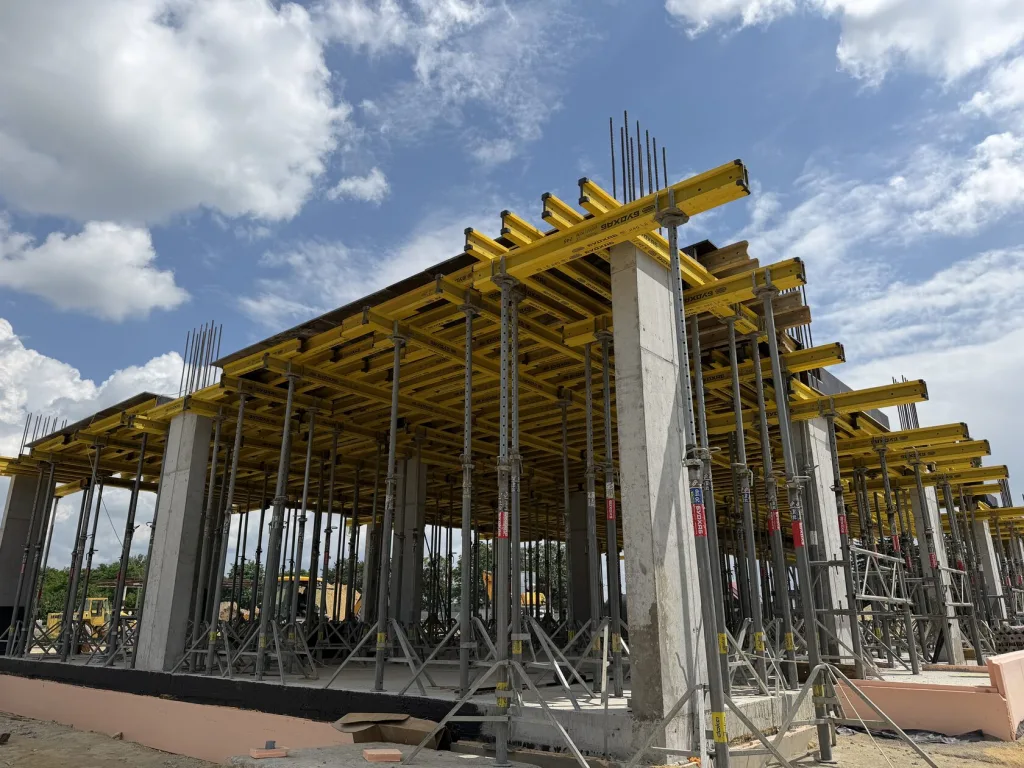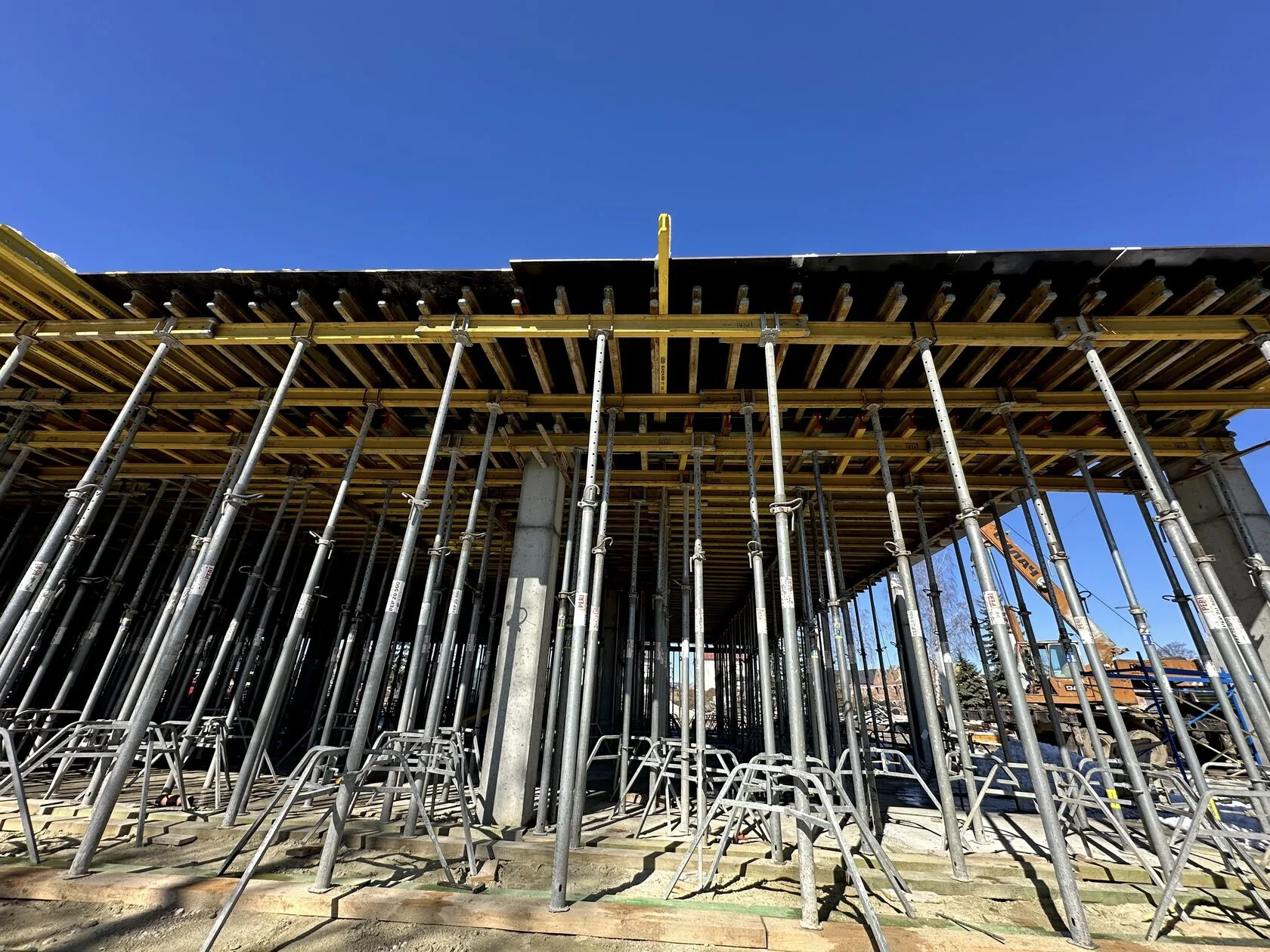
In the floors of monolithic structures, it is not only the beams, plywood, and columns that play an important role. To ensure the formwork system is stable and can withstand the load during concrete pouring and vibration, auxiliary elements are required—tripods, hook-type, and cross (forkhead) heads. It is these elements that secure the beams and columns, maintain the structure’s intended geometry, and prevent shifts and distortions at all stages of concrete pouring.
In this article, we’ll explore how slab formwork accessories work, the different types available, what to look for when choosing them, and why they’re just as important for safe slab formwork operations.
Tripod
A tripod is the first component that ensures the stability of the floor system during assembly. It holds the formwork prop upright until the beams and plywood are installed. Formwork assembly begins with the tripods, because without them, the formwork simply won’t stand.
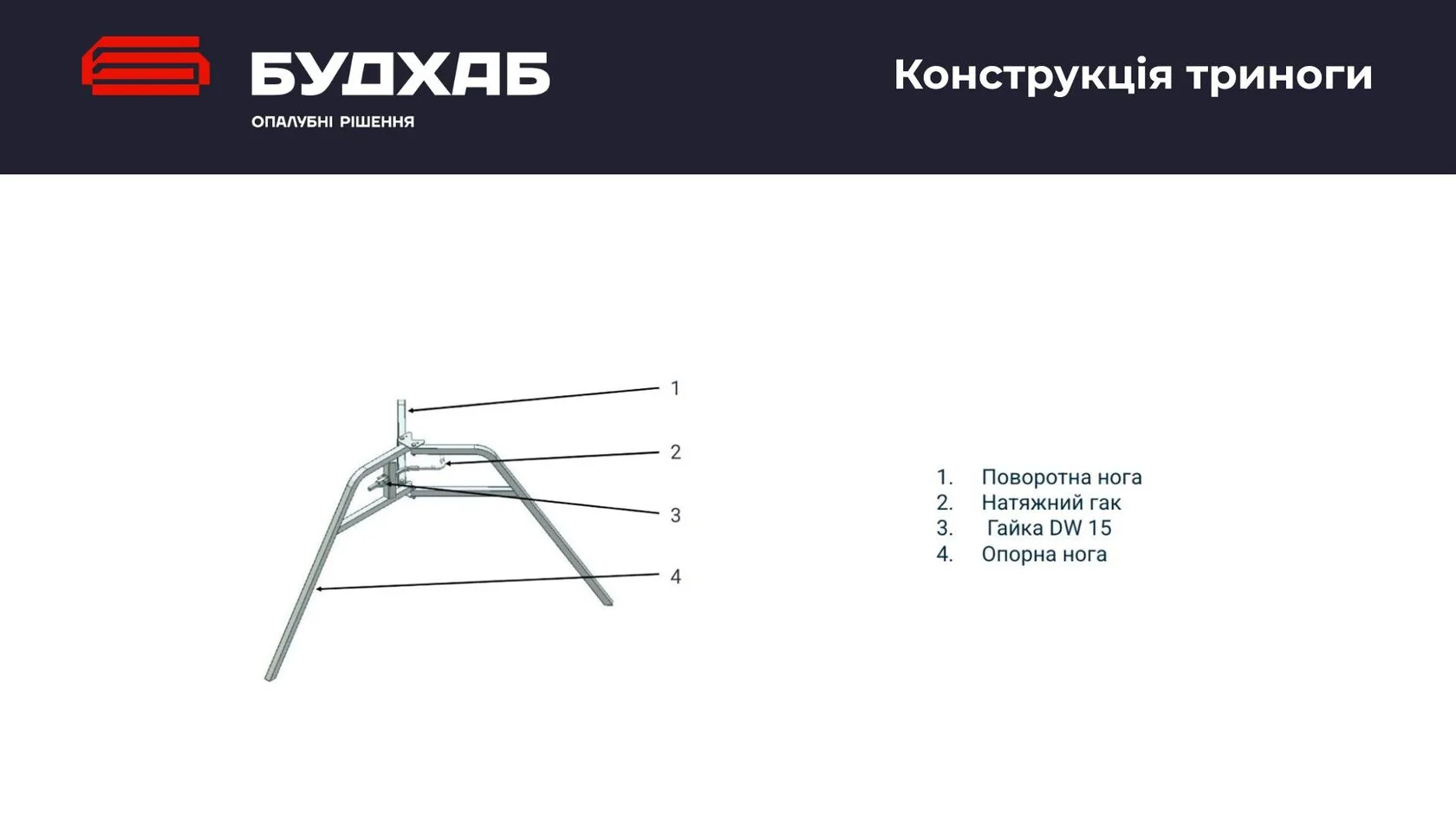
The design of the tripod
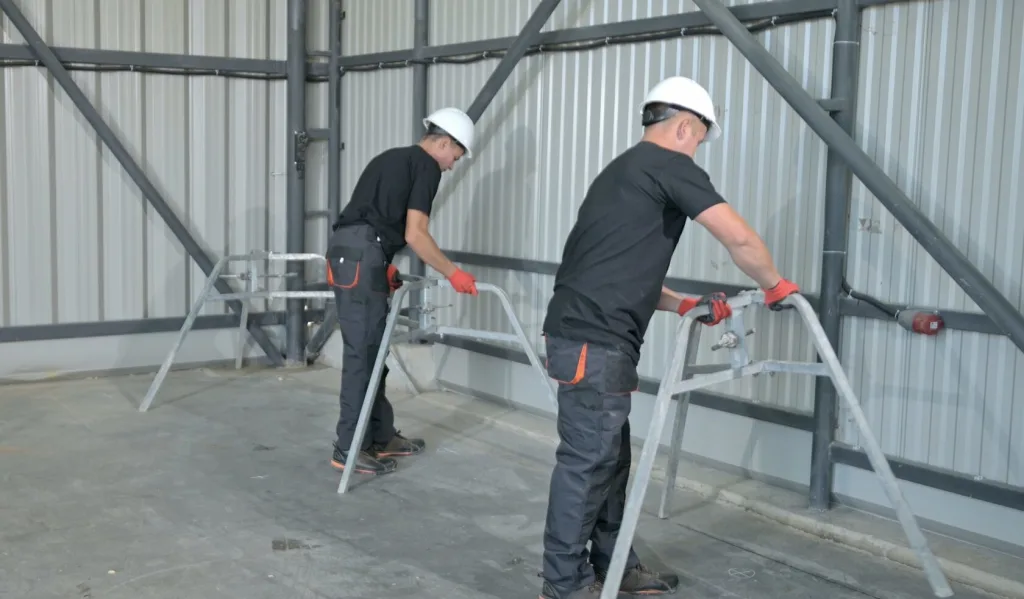
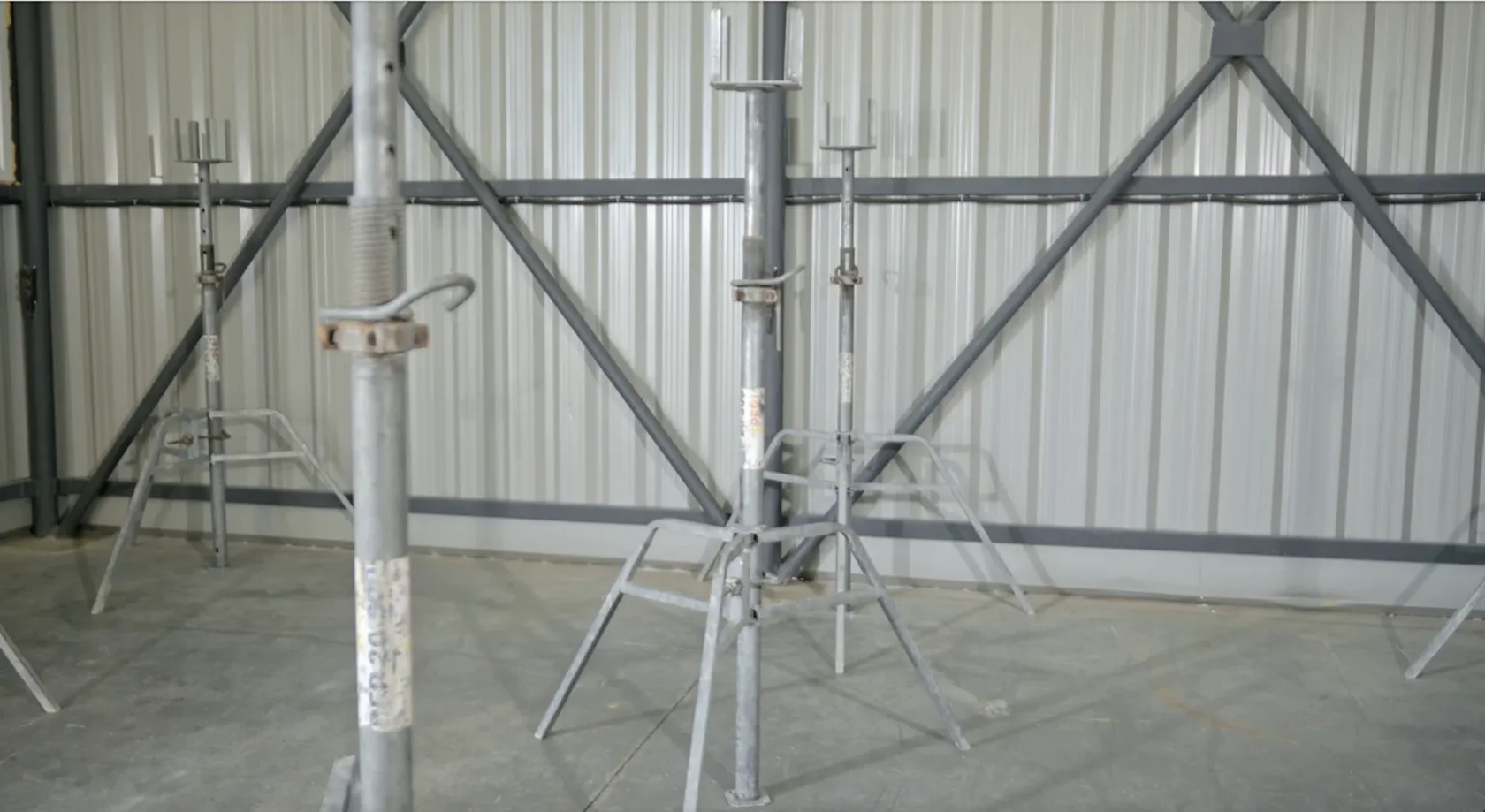
The tripod consists of three support legs that spread out in a plane, creating a wide base for the stand. In the center is a clamping mechanism—a hook or a ring with a screw—that grips the stand’s tube and secures it. Thanks to this design, the tripod ensures simple, quick, and reliable setup.
Features
The main purpose of a tripod is to keep the support upright during the installation of the floor slab. It ensures stability until all components of the system are connected: beams, plywood, and additional supports. Without a tripod, the formwork cannot be used, as the formwork prop simply won’t be able to withstand the weight or shifting and will collapse, making formwork assembly dangerous or even impossible.
Installation points
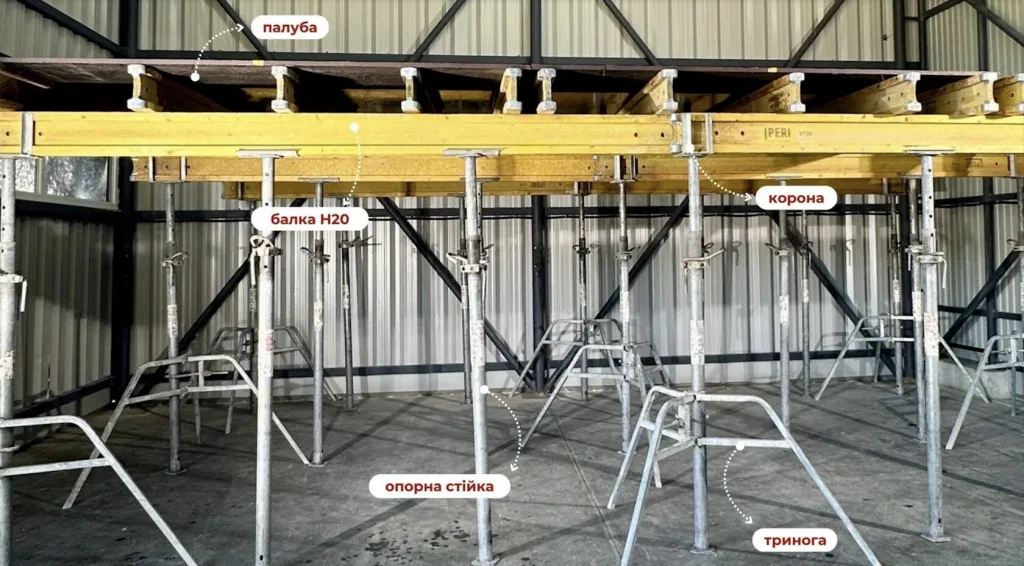
Tripods are not installed on all supports, but only at key points: at the intersections of the main beams or at the start and end points of the spans. It is these points that determine the geometry of the entire structure, which is why they require additional bracing. Intermediate columns are installed only after the system has achieved minimal stability—Tripods are not provided for them.
Varieties
Tripods are used in a variety of settings, so manufacturers offer several models with different technical specifications. Depending on their intended use and operating conditions, they can be categorized based on the following criteria:
- design: lightweight, standard, reinforced
- clamp type: with a sliding lock, a clamping lever, or a screw clamp
- material: galvanized or painted steel
Be sure to check the diameter of the pipe that the tripod can secure—it must match the diameter of the prop. For example, PERI universal tripods are compatible with 60–90 mm props. If the client has their own tripods, it is important to check in advance whether they fit the rented props. Otherwise, the tripod may not secure properly or may hold loosely, creating a risk of instability.
This is particularly relevant when using tall or reinforced props—for example, on sites with commercial floor heights (4 m and above). Such props have a larger pipe diameter, and a standard Tripod may simply not fit.
In addition, reinforced tripods can withstand point loads—it is convenient to step on them when adjusting the pole height, which speeds up installation and is often used in practice. Lightweight tripods are not designed for such loads: they bend or become unstable.
Material
High-quality tripods are made from medium-gauge steel (2.5–3 mm). They have sufficient leg reach and optimal weight—approximately 10 kg—which ensures stability even for 5-meter poles at maximum reach. However, workers sometimes try to use cheaper alternatives made of thin metal: they are significantly lighter but unstable, especially under load. Such cost-cutting often leads to problems on the job site.
By the way, it is precisely when people try to save money or speed up the installation process that the most common mistakes occur, including:
- Setting up tripods in the wrong places, or trying to do without them altogether, is a very common occurrence. Sometimes contractors substitute tripods with whatever is at hand, such as a pipe with a clamp, or fail to secure the end posts at all.
- Incorrect selection of tripod diameter—if the tripod does not fit snugly around the support tube, it will not secure it properly. The support remains “loose,” wobbles, or slips out of place, which means there is a risk of the entire system shifting.
- If you use a tripod that is too flimsy for a tall or heavy support, the entire structure will start to wobble or collapse even before the beams are installed.
Before use, each tripod should be inspected. If one of the legs is bent or the hook does not lock into place, that tripod should not be used in the system. When folded, check to see if all parts are symmetrical. During assembly, it becomes immediately clear whether the locking mechanism is secure: if the tripod wobbles or does not lock into place, there is a defect, and the tripod should be replaced.
Heads
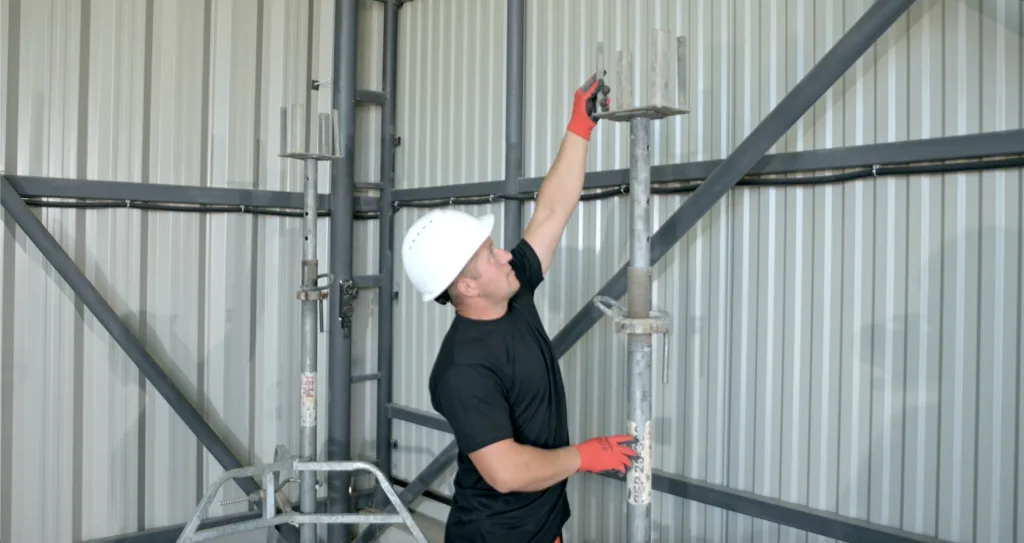
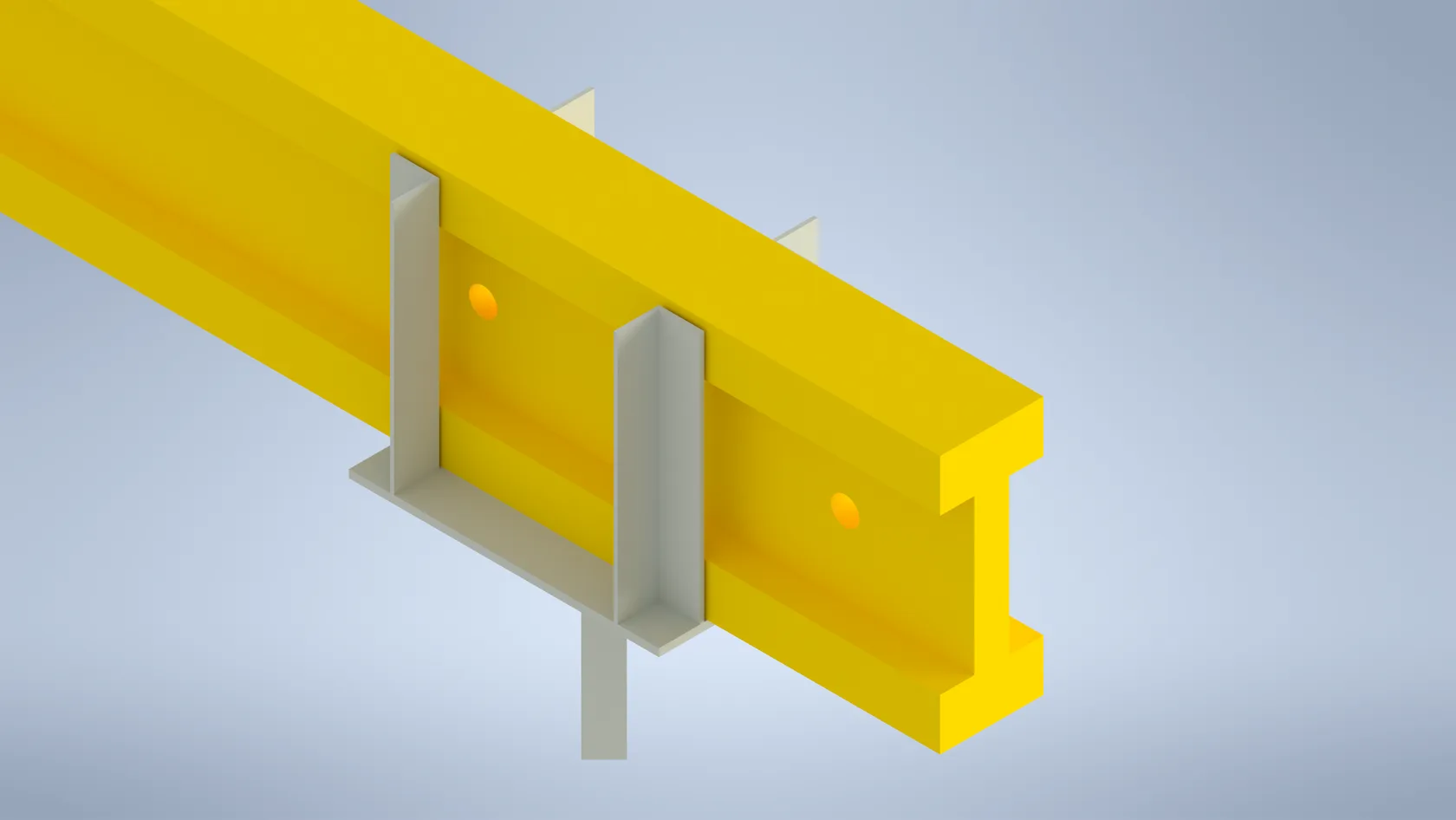
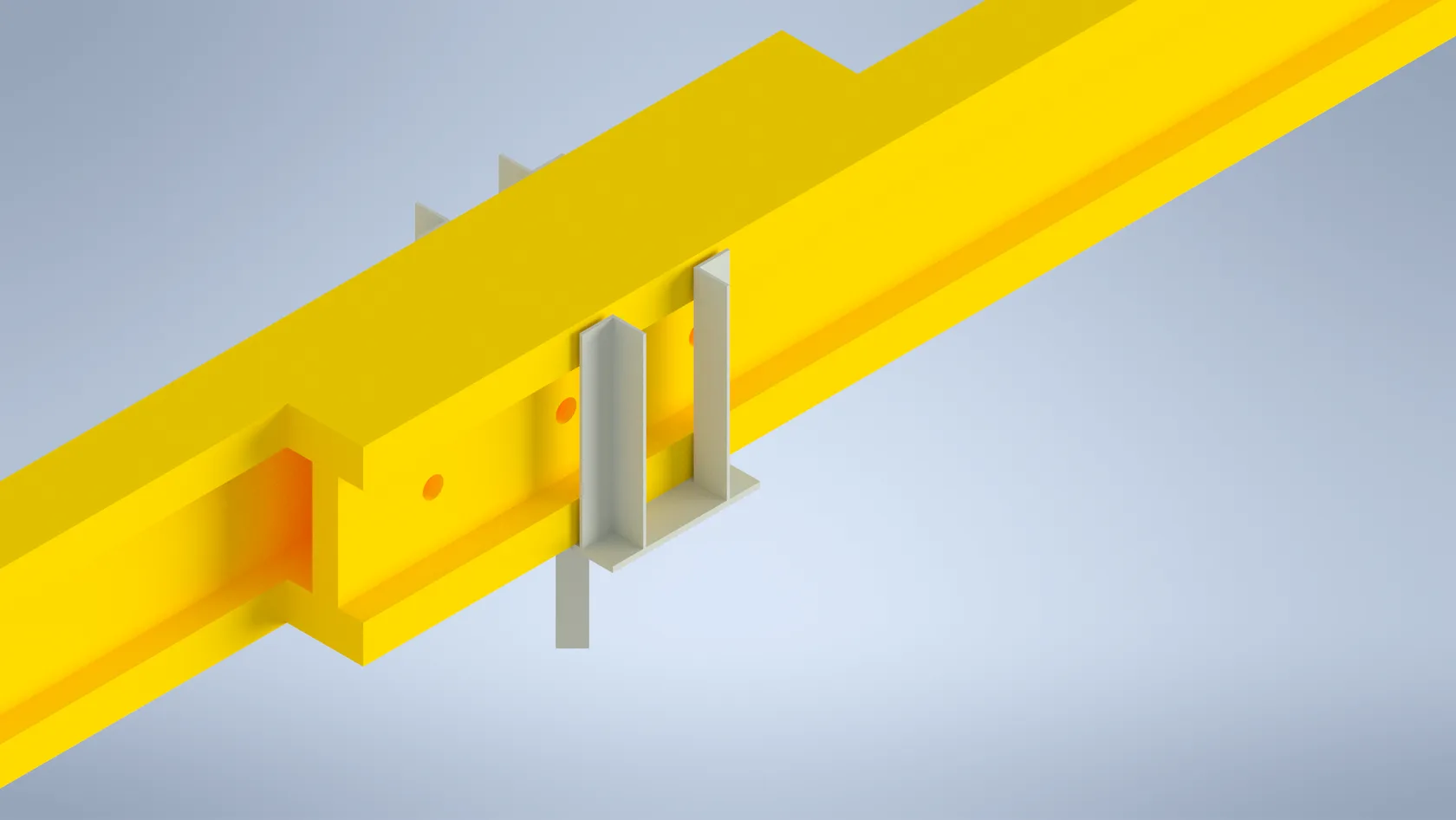
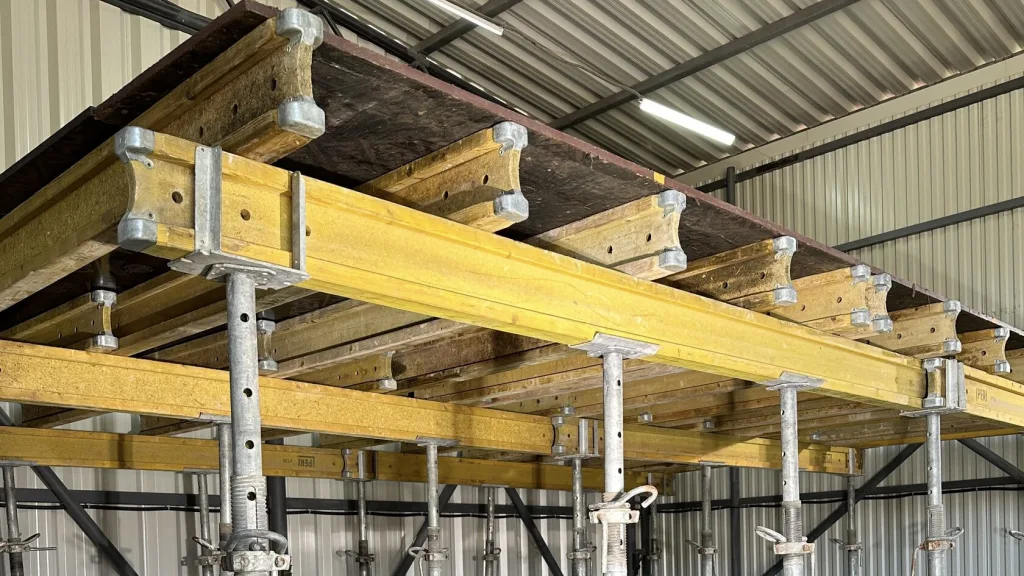
A crosshead, forkhead, universal fork, or four-way forkhead is a metal component with four projections (“horns”) that is mounted at the top of a post. Timber beams are placed on it—one in one direction and two in the perpendicular direction. It is this component that holds the beams in the correct position and prevents them from sliding or falling during work. Without the forkhead, the beam cannot be secured, shifts, or even slides off the post. Therefore, the stability of the entire structure depends on how reliably this connection functions.
Design
This component has a simple yet well-designed shape: a metal cap on top of the post with four protrusions—often referred to as “horns.” They form a cross-shaped structure into which beams can be easily inserted in two directions—one lengthwise, the other crosswise. One direction is for a double beam (the junction of the main beams), the other is for a single beam (the end of the main beam). This design allows you to quickly assemble a support post for a plywood deck without using additional fasteners or brackets.
Material
Forkheads are made of steel. They are either painted or galvanized, and while this does not affect their performance, it does determine their durability: thinner metal wears out faster, while thicker components last longer, even with heavy use.
Function
They serve as a reliable support for the beams and hold them securely in place. It is the forkhead that prevents the beam from sliding, shifting, or falling off the column during installation or under the weight of concrete. Without this element, the beam has no rigid connection to the column, so even a slight shift can disrupt the floor’s geometry or create a hazardous situation at the site.
Lowering heads are a separate category—they are the same type as the forkhead, but with an additional mechanism. After concrete placement, this head allows the deck to be partially lowered without having to remove the entire system at once. This simplifies dismantling, speeds up formwork removal, reduces the risk of equipment damage, and extends the threaded mechanism’s service life on the struts.
Another type is the hook-on, or support, head. It is installed on intermediate posts that do not have Tripods. This head secures the beam from below, thereby preventing it from shifting or sagging during operation. Technically, you don’t have to install it—after all, the post rests against the beam and seems to hold it in place. But if someone nudges the structure, the beam could fall out. In some cases, it is secured with nails through holes in the post, but this damages the beam and shortens its service life. Therefore, it is better to use a full-fledged head—it is more reliable and safer.
How to Check the Condition of Auxiliary Components: Practical Tips
At Budhub, we often notice that even experienced teams run into problems not because of the equipment itself, but because of details they simply overlooked. Here are 4 simple steps to check before installation to avoid unpleasant surprises.
- Inspect the tripods. Make sure the legs are straight and free of warping. The clamp should move freely and hold the pipe securely. If anything wobbles or doesn’t lock into place, it’s best to replace it.
- Check the forkheads. The horns should be straight, with no breaks or bends. The beam should fit snugly and not be warped.
- Don’t stop at a visual inspection. Even a component that looks intact may not be functioning properly. A visual inspection is only the first step.
- Try setting it up. The best test is to set it up. If the tripod can’t hold the pole and the head can’t hold the beam, you’ll see it right away. In real-world conditions, these issues become apparent quickly.
The technical inspection of tripods, forkheads, and hooking heads is not a mere formality, but a critical step that affects the stability of the formwork system, on-site safety, and the overall pace of construction work. Timely detection of defects or wear helps avoid downtime, rework, and the risk of structural damage even before concrete pouring begins.
We hope these tips will be useful to your team and help make the installation process quick, safe, and predictable.
If you need advice or help with putting together a package, please contact us at:
+38 098 800 22 88